Playable ads cost different amounts depending on who you ask, and most answers are answering a question nobody actually posed. The real question isn’t “what does it cost to build one.” It’s “what does it cost, compared to what I’m currently spending to get worse results.” Those are different conversations, and conflating them is why so many budget approvals for playable ads stall in the same meeting where someone pulls up a $30,000 quote next to a $500 static banner and asks why anyone would do that.
We’ve built playable and interactive ad experiences long enough to know the honest answer has two halves: what you pay to build the thing, and what you pay to run it. Skip either half and the number you’re quoting is meaningless. Here’s both, with sources.
What You’ll Actually Pay To Build One
Production cost for a playable ad scales almost entirely with three variables: how many scenes it has, how much custom art and animation it needs, and how much engineering it takes to make it feel responsive instead of janky. Everything else — sound design, localization, the number of ad networks it needs to run on — moves the number at the margins, not the core.
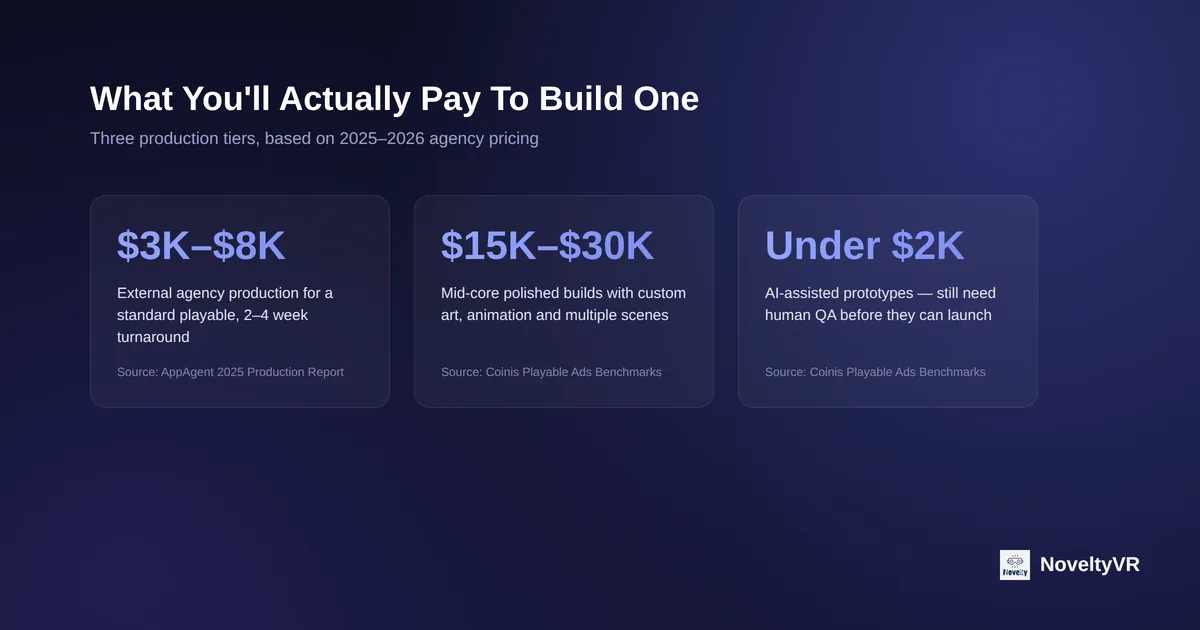
At the low end, AppAgent’s 2025 production report puts external agency pricing for a standard playable at $3,000–$8,000, with a two-to-four-week turnaround. That buys a single-mechanic playable: tap-to-match, swipe-to-dodge, drag-to-fit — something that demonstrates one core loop cleanly.
Move up to a mid-core build — custom illustrated art, multiple scenes, branching interactions — and Coinis’s playable ad benchmarking puts the range at $15,000–$30,000. Above that, fully custom multi-scene builds with bespoke character animation and original music can run $30,000–$80,000, though very few brands need to spend there for a first campaign.
There’s a newer, cheaper tier worth naming honestly: AI-assisted prototyping can produce a rough, testable playable for under $2,000. That’s real, and it’s changing how agencies scope early-stage work. What it doesn’t replace is human QA, device testing across screen sizes, and the polish pass that keeps a playable from feeling like a tech demo. Treat the AI-generated version as a fast way to validate a concept before committing to a full build, not as a finished deliverable.
The Cost You’re Not Pricing In: Media Spend
Here’s where most cost conversations go wrong: they stop at production and never get to the number that actually determines ROI — what it costs to run the ad in front of people.
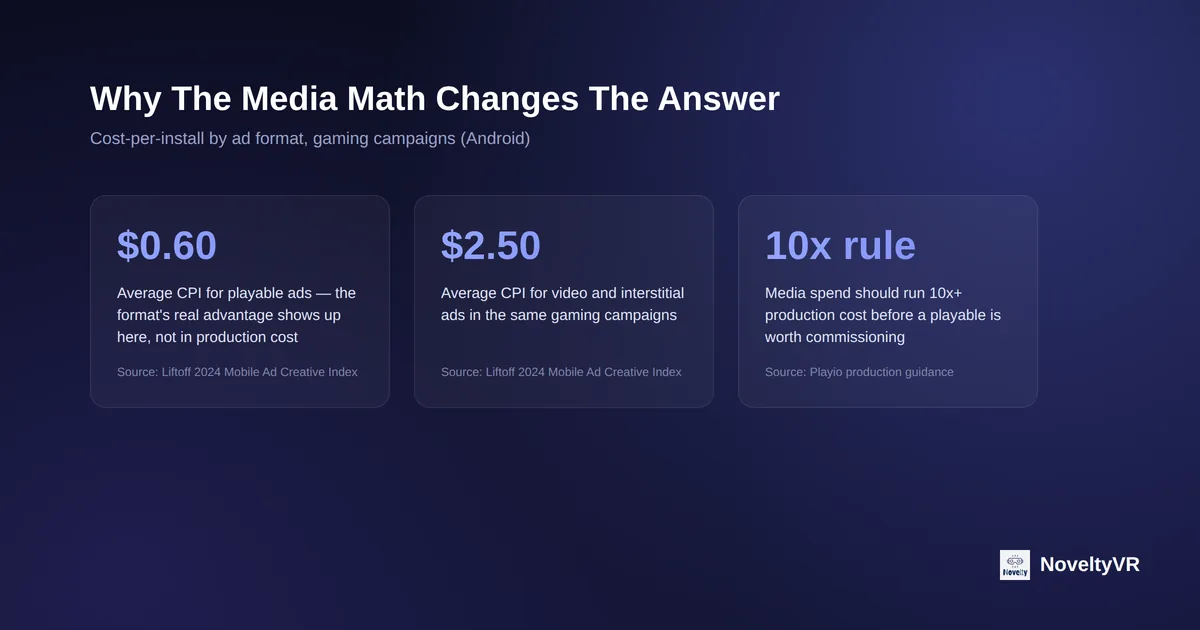
Liftoff’s 2024 Mobile Ad Creative Index, tracking gaming campaigns on Android, found playable ads running at an average cost-per-install of $0.60 — against roughly $2.50 CPI for video and interstitial formats in the same campaigns, and $5.91 for iOS video specifically. That’s not a rounding difference. A playable that costs six times more to produce than a banner ad can still come out dramatically cheaper per install once it’s live, because it converts better per impression.
Coinis’s benchmarking on the publisher side shows a similar pattern in eCPM terms: tier-1 gaming markets see playable inventory trading at $10–$30 eCPM, broadly in line with rewarded video ($16.49–$19.63) and ahead of standard interstitial placements. The format isn’t cheap to buy media for — it’s competitive, which is a different thing.
There’s a real, sourced example of this math playing out. Hookin.io documented a six-week, $200,000 test by a puzzle game studio that split spend between a $16,000 playable build and standard video creative. The playable came in at $4.11 CPI with 23% D7 retention, against $6.25 CPI and 13% D7 retention for video — and drove 74% of total installs on just 65% of the media budget. We’re citing this as a third-party-reported industry case, not a NoveltyVR client project, and the specific studio isn’t named in the source.
The Rule Of Thumb That Actually Matters
Playio’s production guidance offers a useful gut-check: media spend should run at roughly ten times production cost or more before a custom playable is worth commissioning. A $10,000 playable makes sense against a $100,000+ media budget. It doesn’t make sense against a $5,000 test campaign — not because the format doesn’t work at small scale, but because you won’t spend enough to recoup the upfront build cost even if it converts brilliantly.
This is the single most useful filter for deciding whether “playable ads cost too much” is actually true for your situation, or whether it’s the wrong format for your current budget stage.
In-House vs. Agency: Where The Line Actually Sits
If you’re weighing whether to build a playable capability internally or brief it out, the volume math is fairly clean. Below three to four playables a month, outsourcing to a specialist studio is almost always cheaper once you account for the creative, engineering, and QA headcount an in-house team requires. Past five or more builds a month, the fixed cost of an internal team starts to beat per-project agency pricing — but that threshold assumes you already have development and design capacity to repurpose, not capacity you’d be hiring from scratch.
For most brands running one or two playable campaigns a quarter, briefing a studio remains the more capital-efficient choice, even before factoring in that a specialist team already has the engineering shortcuts that keep quotes at the lower end of these ranges. If you want to see what that looks like in practice, these playable ad examples that outperform video break down what separates a well-built playable from a wasted budget.
What Actually Moves The Price
A handful of decisions shift a quote more than anything else on this list:
- Number of scenes. A single-loop playable and a three-act playable with a win state and a branching path are not the same production, even if both are “one playable ad.”
- Custom art vs. template art. Original illustration and character design cost meaningfully more than adapting an existing visual style or template.
- Ad network count. Meta, TikTok, Google, and Unity Ads all have slightly different playable specs. Supporting four networks from one build costs more than supporting one.
- Localization. Text and voice localization for multiple markets is billed separately from the base build in almost every quote we’ve seen.
- Timeline compression. A two-week rush costs more than a four-week standard turnaround, for the same scope.
For a fuller picture of how playables stack up against other formats beyond just price, this interactive vs. video ad performance data is a useful companion to the numbers above. And if you’re still deciding whether playable is the right format at all, our complete guide to what playable ads are and how they work is the place to start.
Frequently Asked Questions
What is the average cost of a playable ad in 2026?
Standard external production runs $3,000–$8,000 for a single-mechanic playable, per AppAgent’s 2025 report. Mid-core builds with custom art run $15,000–$30,000, and fully custom multi-scene productions can reach $30,000–$80,000, according to Coinis’s playable ad benchmarks.
What is the minimum budget needed for a custom playable ad?
Below roughly $3,000 you’re generally looking at heavily templated or AI-assisted prototypes rather than a fully custom build. Those can still be useful for concept testing, but budget for a human QA and polish pass before running them at scale.
How long does it take to build a playable ad?
Simple playables typically take 3–7 working days with a specialist studio; complex, multi-scene builds run 1–3 weeks. AI-assisted prototyping can produce a rough first version in 1–3 days, though it still needs a review and optimization pass before launch.
What is the average CPM or CPI for playable ads?
On cost-per-install, Liftoff’s 2024 Mobile Ad Creative Index found playable ads averaging $0.60 CPI in Android gaming campaigns, against roughly $2.50 for video and interstitial formats. On the publisher side, Coinis reports playable eCPMs of $10–$30 in tier-1 gaming markets.
How much media spend do I need to justify a playable ad’s production cost?
A commonly used benchmark, per Playio, is media spend at ten times production cost or more. Below that ratio, the format is harder to justify purely on ROI grounds, even when it performs well per-install.
Where This Leaves You
Understanding what playable ads cost — both to build and to run — is what makes the “playable ads are expensive” objection usually collapse once you separate the two numbers it’s actually made of. Production cost is real and scales with complexity — that part of the objection is fair. But priced against what you’re actually paying per install on video or static formats, a playable frequently comes out ahead, not behind. The format isn’t right for every budget stage; it’s specifically right once your media spend is large enough to make the upfront build cost a rounding error against what you save per install.
If you’re trying to figure out where your specific budget and campaign goals land on that math, get a quote and we’ll tell you honestly whether a playable makes sense at your spend level — or whether a simpler interactive format gets you there for less.