
Most “best playable ad examples” roundups do the same thing: five screenshots, a one-line caption under each, and a closing line about how playable ads are “the future of mobile advertising.” You’ve probably already read three of them this year. None of them tell you what the team actually changed, what number moved because of it, or where to find the source.
This one is different on purpose. Every example below is a real, named campaign or a documented, sourced case study — not a hypothetical, not a composite, not a number we made up to sound impressive. Where the underlying data comes from an anonymized industry report rather than a named brand, we say so, because that distinction matters if you’re the one signing off on a media budget based on it.
We build playable ads and interactive marketing technology for a living, so we read a lot of these case studies — partly for competitive awareness, partly because the mechanics that work keep repeating across categories that have nothing else in common. Here are ten worth knowing, and the pattern that connects them.
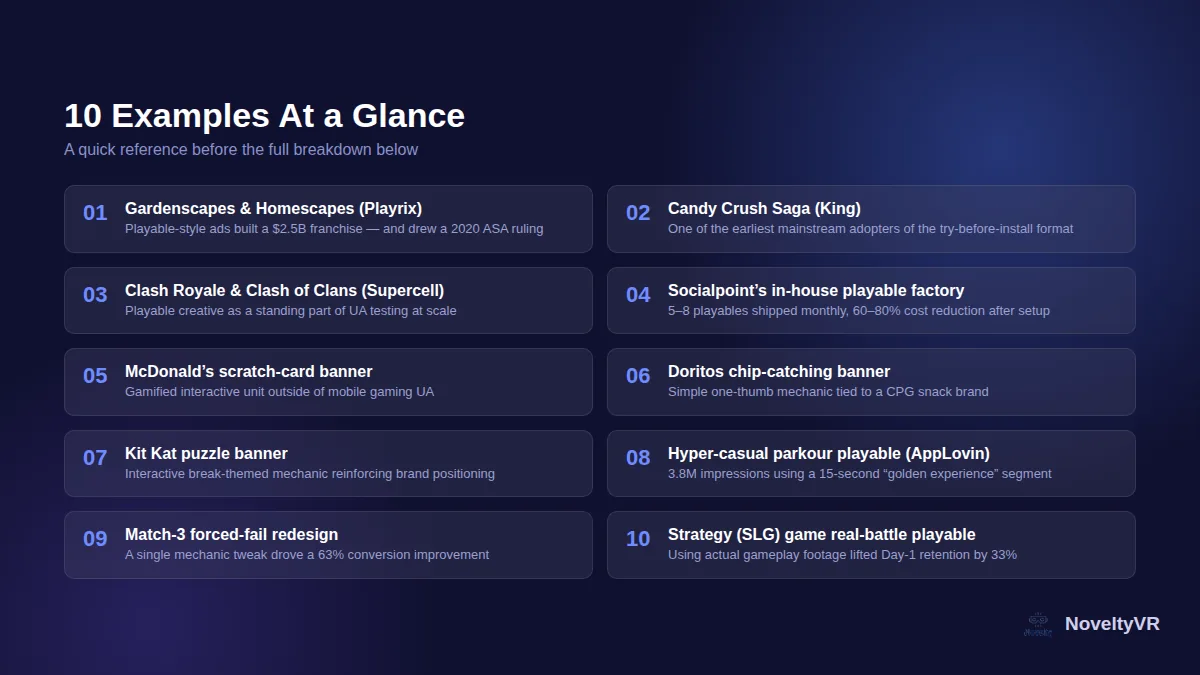
1. Gardenscapes and Homescapes (Playrix) — The Cautionary Tale That Still Prints Money
No list of playable-style ad examples is complete without Playrix’s match-3 franchise, and not just because it worked. Gardenscapes and Homescapes have driven over 540 million downloads and roughly $2.5 billion in revenue, built substantially on interactive ad creative — mini-games like “pull the pin” and “restore the mansion” puzzles that promised a specific kind of gameplay.
The catch: those mini-games represented something like 1% of actual in-game content. The UK’s Advertising Standards Authority ruled the ads misleading in 2020, finding that players would have to work through a significant amount of different gameplay before ever reaching what the ad had shown them. Playrix’s response afterward was to rework the games so those mechanics appeared earlier and more often — closing the gap between the ad’s promise and the product’s reality instead of abandoning what clearly worked creatively.
The lesson isn’t “get away with it.” It’s that the ads worked because they were genuinely fun to play in isolation, and that a playable ad’s interactive core has to survive contact with regulators and reviewers, not just with a performance dashboard. If your mechanic can’t honestly represent the product, the fix is to change the product’s onboarding, not to keep running the ad and hope nobody official downloads it.
2. Candy Crush Saga (King)
King was one of the earliest mainstream studios to lean into try-before-you-install advertising, and Candy Crush’s ad creative is still commonly cited in ad-tech industry writeups as a reference point for the format. The mechanic barely needs explaining — it’s the same match-3 loop as the game itself, playable in miniature inside the ad unit — which is precisely the point. There’s zero translation gap between what you play in the ad and what you get after tapping install.
3. Clash Royale and Clash of Clans (Supercell)
Supercell treats playable creative as a standing part of its user-acquisition testing process rather than a one-off campaign tactic, running interactive ad variants alongside video and static creative across networks as a matter of course. What’s instructive here isn’t a single headline metric — it’s the operating model: playable ads as permanent creative infrastructure you continuously test and iterate, not a special project you greenlight once a quarter.
4. Socialpoint’s In-House Playable Factory
Socialpoint (the studio behind Dragon City and Monster Legends) built its playable ad production in-house rather than outsourcing it project by project, and the economics of that choice are documented: the team produces roughly 5 to 8 playables a month across three live titles, and reports a cost reduction of 60 to 80% once the initial tooling and template investment was made.
That’s the part brand marketers evaluating this format tend to miss. The first playable ad you commission is expensive relative to a banner. The fifth one, built on the same reusable mechanic with a new skin, is not — which is exactly the argument our complete guide to playable ads makes about treating the mechanic as reusable infrastructure rather than a one-off asset.
5. McDonald’s Scratch-Card Banner
Not every useful example comes from mobile gaming. McDonald’s has run gamified banner ads built around a scratch-off mechanic — reveal a hidden prize by dragging across the unit — a format documented in interactive-ad roundups as one of the more widely deployed gamified banner types among CPG and QSR brands. It’s a simpler, lighter-weight cousin of the HTML5 mobile-UA playable, but it runs on the same psychological principle: a small, low-effort action that earns a reward feels different from a passive impression.
6. Doritos Chip-Catching Banner
Doritos has used a similarly simple interactive banner format: a chip-catching mini-game embedded directly in a display unit. Like the McDonald’s example, this isn’t a full HTML5 playable ad in the mobile-UA sense — no install prompt, no end card funnel — but it’s built on the identical mechanic: tap or drag, get a small win, associate that feeling with the brand. For CPG advertisers who don’t have an app to install, this is usually the more realistic entry point into interactive creative than a full playable build.
7. Kit Kat Puzzle Banner
Kit Kat’s interactive banner work has taken a puzzle format, tying the “have a break” positioning to a short, self-contained interaction rather than a straight video cutdown. It’s a small example, but it makes a point worth remembering: the mechanic doesn’t need to be clever to work. It needs to take about two seconds to understand and be satisfying to finish.
8. A Hyper-Casual Parkour Playable on AppLovin — 3.8M Impressions
This one comes from an anonymized case study published by Business of Apps rather than a named brand, so we’re flagging that clearly rather than attaching a company name that wasn’t disclosed. A hyper-casual parkour game ran a playable ad on the AppLovin network that generated 3.8 million impressions using what the studio called a “golden experience” — a tightly designed 15-second segment with progressive difficulty, engineered so most players hit a satisfying peak moment right before the install prompt appears rather than after they’ve already lost interest.
The design principle transfers well outside gaming: place your call-to-action at the point of maximum earned satisfaction, not at a fixed timer regardless of what the user is feeling in that moment.
9. A Match-3 Game’s Forced-Fail Redesign — 63% Conversion Lift
Also from Business of Apps: a match-3 title improved conversion by 63% by introducing a “forced-fail” point at level three — deliberately letting the player lose just before they’d otherwise win, then offering the install as the way to keep playing and actually finish the level.
This sits close to a line worth being careful about. There’s a real difference between “make the demo hard enough that finishing it feels earned” and “manufacture a fake loss to manipulate someone into installing.” The Gardenscapes example above is the reminder of what happens when that line gets crossed publicly. Used honestly, forced-fail is a legitimate difficulty-curve decision; used to bait, it’s the exact behavior that drew a regulatory ruling.
10. A Strategy Game’s Real-Battle Playable — 33% Better Day-1 Retention
The third Business of Apps case: a strategy (SLG) game swapped a stylized ad mockup for a playable built from actual in-game battle scenes — same UI, same character art, same combat system players would see after installing — and saw Day-1 retention improve by 33% among users who converted through it.
This is the self-selection effect that shows up across nearly every credible playable ad study: when the ad experience matches the product experience exactly, the people who convert already know what they’re getting, and they stick around longer because of it. It’s the inverse of the Gardenscapes situation — same underlying mechanic (playable ad drives installs), opposite outcome, because the ad told the truth.
What the Data Shows Across These Examples
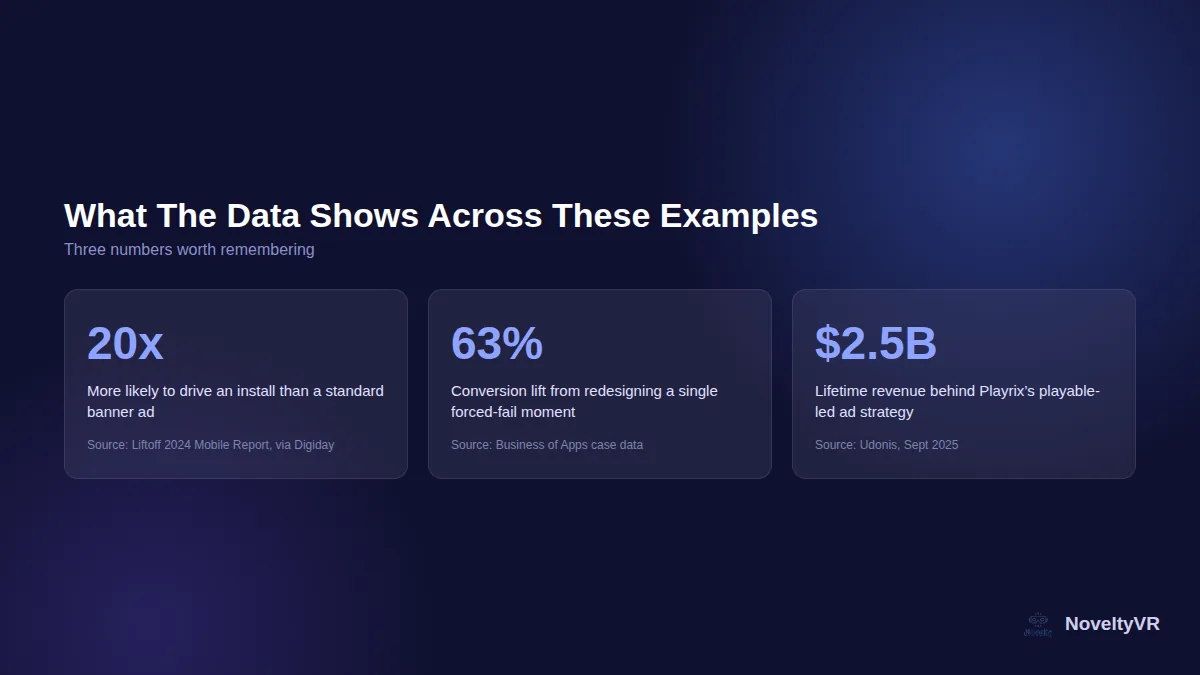
A few aggregate numbers are worth citing here, with their sources, because they explain why the pattern above repeats across such different companies and categories — for a fuller breakdown of how the formats stack up, see our complete data comparison of interactive ads vs. video ads vs. static ads:
- Playable ads are 20x more likely to result in an install than a standard banner ad, per Liftoff’s 2024 mobile advertising report (cited via Digiday’s coverage of the format).
- Strategically placed interactive creative can be 32% more memorable than video or banner ads run in the same slot, per the same Liftoff-sourced reporting.
- Playables kept under 20 seconds see roughly 30% less churn than the category average of 20-second-plus units — a reminder that “more interactive” isn’t automatically “better,” if it costs you attention.
We’re not citing the “playable ads convert 3x better than video” figure that circulates widely in ad-tech content — not because it’s necessarily wrong, but because in most of the places we found it, it traces back to aggregated, unnamed-account analysis rather than a citable study. The examples above are more useful precisely because each one is either a named campaign or an attributed case study, not a number floating without a source.
The Pattern Across All Ten
Strip away the category differences — mobile games, QSR banners, CPG snacks — and the same three things separate the playable ads that worked from the ones that didn’t:
The mechanic matched the product. Candy Crush’s ad plays like Candy Crush. The SLG game’s ad used real battle footage. Where that match broke down — Gardenscapes’ pin-pulling minigame bearing little resemblance to the core match-3 loop — it became the thing regulators flagged, even while it kept converting.
The reward arrived at the right moment. The AppLovin parkour example engineered its win to land right before the CTA. Forced-fail mechanics, used honestly, do the same thing by making that win feel earned rather than automatic.
Reuse beat one-off production. Socialpoint’s economics only work because the studio treats the mechanic as infrastructure — build once, reskin repeatedly — rather than commissioning a bespoke playable for every campaign.
If you’re evaluating whether this format is worth testing for your own brand, those three questions are a better starting filter than “how much does a playable ad cost.” A well-matched, well-timed, reusable mechanic on a smaller budget will consistently outperform an expensive one-off that gets any of the three wrong.
FAQ
What are the best playable ad examples to study?
Gardenscapes and Homescapes (Playrix), Candy Crush Saga (King), and Clash Royale (Supercell) are the most-cited mobile gaming examples. Outside gaming, McDonald’s, Doritos, and Kit Kat have all run gamified banner formats built on the same interactive principle.
Do playable ads only work for mobile games?
No. Gamified banner ads — scratch cards, catching mechanics, puzzles — extend the same core idea to CPG, QSR, and other categories that don’t have an app to install. Our complete guide to playable ads covers how ecommerce, fintech, and FMCG brands are adapting the format.
What’s the biggest risk in playable ad design?
Misrepresenting the actual product. Playrix’s 2020 ASA ruling over Gardenscapes and Homescapes is the clearest public example of what happens when the ad’s mini-game and the real game diverge too far — regulatory action, even on a campaign that was otherwise commercially successful.
How much does a playable ad cost to produce?
Custom playable ads typically range from $3,000 to $25,000+ depending on complexity and platform variants, covered in detail in our playable ads guide. Studios that build reusable mechanics, like Socialpoint’s in-house model, report 60–80% lower costs per additional variant after the first build.
Key Takeaways
- The most-cited playable ad examples — Candy Crush, Clash Royale, Gardenscapes — succeed because the ad mechanic mirrors the actual product experience.
- Gamified banner formats (McDonald’s, Doritos, Kit Kat) extend the same interactive principle to brands without an app to install.
- Documented case studies show real, sourced performance lifts — 63% conversion improvement from a forced-fail redesign, 33% better Day-1 retention from using real gameplay footage — without needing to round up to an unverifiable headline number.
- The line between an earned win and a manipulative one matters: Gardenscapes’ regulatory scrutiny is the clearest evidence of what happens when a playable ad’s promise outruns the product.
- Reusable mechanics, not bespoke one-off builds, are what make playable ads economically sustainable at scale.
Conclusion
The honest version of “playable ads beat video” isn’t a single multiplier you can quote in a slide. It’s ten different companies, in categories that don’t overlap, independently arriving at the same three design decisions — because attention is scarce enough now that asking someone to do something, however small, still earns more trust than asking them to watch something and take your word for it.
If you’re weighing whether a playable ad is worth building for your next campaign, look for a version of your product that would survive the Gardenscapes test: could you show someone exactly what they’re going to get, make it fun for fifteen seconds, and still want them to install?
Want to see what that could look like for your brand? Book a strategy call with NoveltyVR and we’ll walk through examples relevant to your category and budget.