
Almost every marketing team eventually runs into the exact same wall with lead capture forms.
The dilemma is predictable: if you trim your form down to three bare fields—name, email, and company—your landing page conversion rate jumps, but your sales team immediately complains that the inbound leads are unqualified tire-kickers. If you add the five qualification fields your sales team actually needs—budget, timeline, current tech stack, team size, and role—your bounce rate climbs, mobile visitors abandon, and cost-per-lead spikes.
For years, the industry treated this trade-off as an immutable law of digital marketing: you could have high conversion volume or deep qualification data, but never both.
Gamified lead generation breaks that trade-off by changing the fundamental psychology of the interaction. Instead of asking a prospective buyer to fill out a digital interrogation form before receiving anything in return, a gamified capture flow turns the submission into an interactive, two-way value exchange.
Here is the data, the psychological mechanisms, and the real-world benchmarks comparing gamified lead forms against standard static forms in 2026.
The Conversion Data: What the Benchmarks Actually Show
When comparing lead form formats, looking at single-campaign case studies can be misleading. Individual results swing wildly based on ad spend, brand recognition, and audience warmth. What matters are large-scale cross-industry benchmark datasets.
In a comprehensive email capture study analyzing over 779 million impressions, ODICCI’s benchmark research established that standard static sign-up forms average a 3.53% conversion rate. In contrast, interactive and gamified capture formats averaged 9.18%—a 160% relative conversion lift (2.6x) across the same traffic conditions.
This tracks closely with broader landing page data. According to Unbounce’s Conversion Benchmark Report, which evaluated data across more than 41,000 landing pages and 57 million conversions, median conversion rates for traditional lead generation across industries hover between 2.8% and 4.2%. Unbounce’s data confirmed that while three-field forms can occasionally reach roughly 10% conversion, each additional form field past the third cuts completion rates by 8% to 15%.
The problem is that in B2B and high-consideration consumer categories, a three-field form does not give sales reps enough context to prioritize outreach.
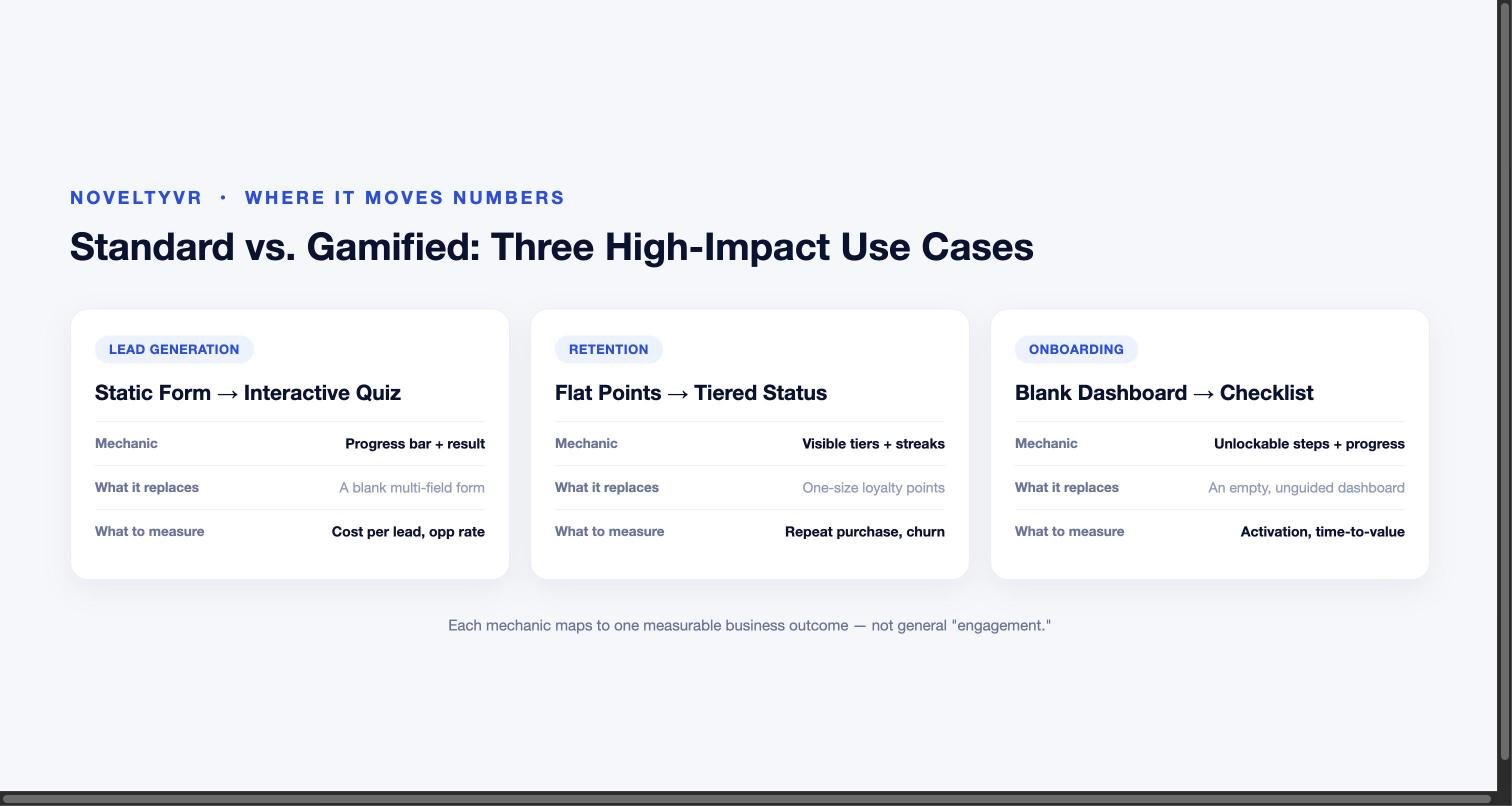
When teams replace passive input fields with progressive, interactive mechanics—such as multi-step assessments, visual product matchers, or customized ROI calculators—the numbers shift dramatically:
- Average Static Form Conversion: 2.5% – 3.8% across B2B and e-commerce landing pages.
- Average Gamified Form Conversion: 8.5% – 12.4% across comparable traffic sources.
- Interactive Quiz & Assessment Completion: 30% – 50% completion rates once visitors initiate the first interactive question (Demand Metric).
- Session Engagement: Gamification mechanics drive an average 3.4x increase in session duration, moving visitors from passive scrollers to active participants.
As we explored in our benchmark analysis on interactive vs. video and static ad performance, active participation fundamentally alters how users process brand messaging.
The Psychology of Form Fatigue vs. The Sunk Cost of Play
To understand why gamified lead forms convert at more than double the rate of standard web forms, you have to look at the cognitive friction of a form field.
A standard form presents all its friction upfront. A user lands on a page and is greeted by 6 to 9 empty rectangular text boxes. Before typing a single character, their brain evaluates three distinct friction costs:
- Cognitive Effort: Reading labels, clicking inputs, toggling mobile keyboards, and typing out text.
- Privacy Perception: Wondering whether submitting their work email will trigger an aggressive BDR outreach sequence within 90 seconds.
- Asymmetric Value: The user gives away their personal data immediately in exchange for a vague promise of a “free PDF report” or “consultation.”
Gamified forms reverse this sequence through three proven behavioral mechanics:
1. Progressive Disclosure and Micro-Commitments
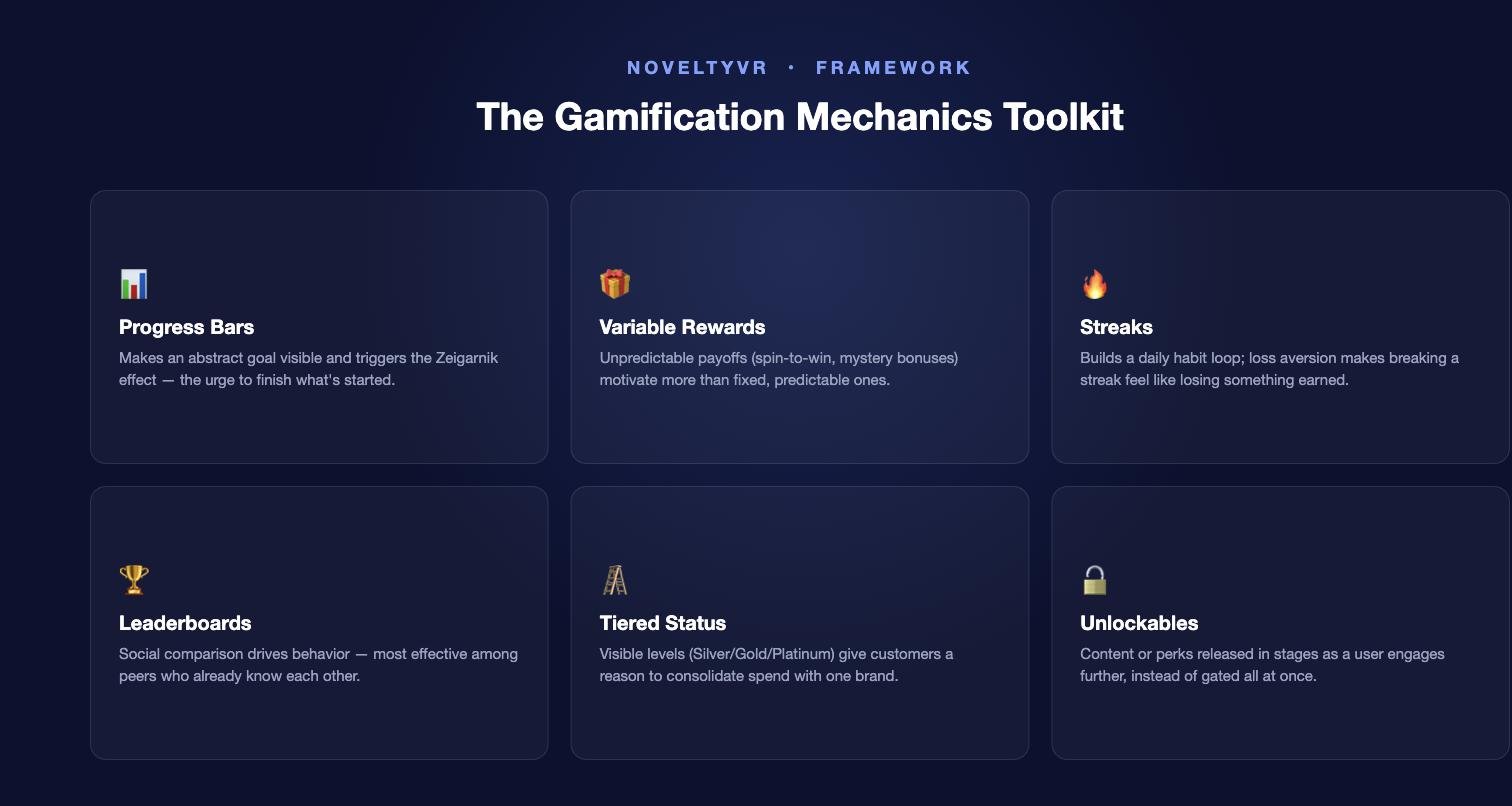
Rather than confronting the user with a monolithic block of form fields, gamification uses micro-commitments. The user is invited to make a single, frictionless click: selecting an industry, tapping an avatar, or choosing their biggest business bottleneck.
Under the psychological principle of progressive disclosure, each low-stakes tap builds momentum. By the time the user reaches the final contact capture screen, they have already invested 30 to 60 seconds of focused attention. The psychological cost of abandoning the interaction suddenly exceeds the minor effort of submitting an email address to receive their tailored result.
2. The Law of Reciprocity
Static forms demand data before delivering value. High-performing gamified lead generation—whether an interactive benchmark tool, an HTML5 assessment, or a custom playable experience—provides instant feedback, scores, or tactical tips during the interaction itself. Because the brand has already provided engaging utility, asking for a work email to save the report feels like a fair exchange rather than an extraction.
3. Curiosity and the Zeigarnik Effect
The Zeigarnik effect states that human beings remember uncompleted tasks far better than completed ones, creating mental tension until resolution is reached. When a user participates in an interactive audit or mini-game, they have an active open loop. They want to see their score, claim their unlocked perk, or view their custom diagnosis. The form at the end is no longer a barrier; it is the final step to closing that open loop.
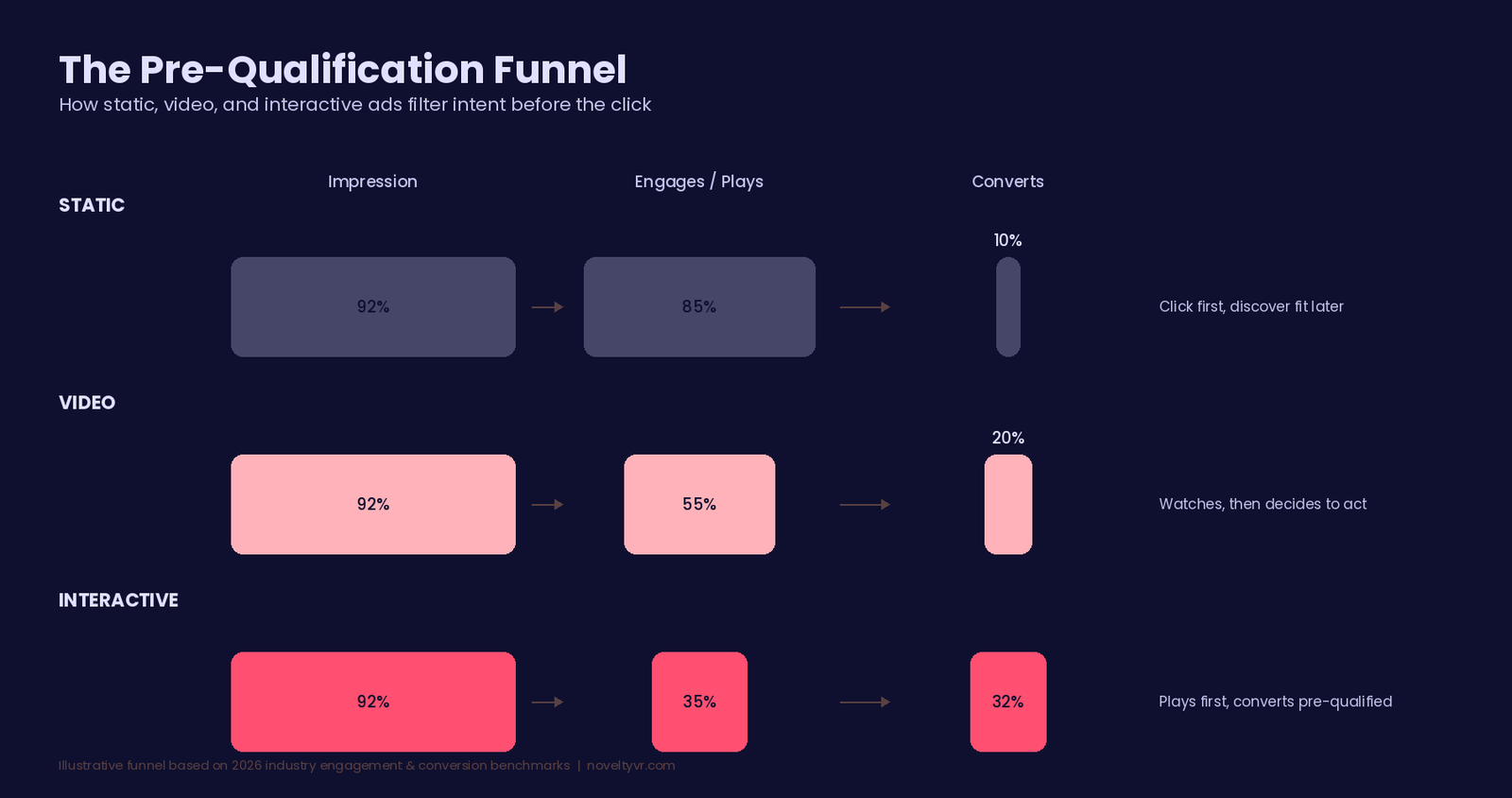
The Lead Quality Debate: Does Gamification Attract Junk Leads?
The most common objection marketing directors and B2B founders raise against gamified lead generation is lead quality: “If we turn our form into a game, won’t we just attract low-intent unqualified leads and freebie-seekers?”
The honest answer is: it depends entirely on which gamification mechanics you choose.
There are two fundamentally different approaches to gamification in lead capture, and confusing them is where marketing budgets get burned:
Low-Intent Gamification (The “Spin-the-Wheel” Trap)
This is the mechanic most commonly seen on discount e-commerce sites: a spinning roulette wheel offering 10% to 50% discounts or an entry to win a consumer gadget.
While spin-to-win widgets can drive high opt-in rates (often 11% to 15%), the lead quality is notoriously poor for considered purchases. The incentive is disconnected from the product value. Visitors enter temporary or throwaway emails simply to win the prize. If you run a B2B SaaS platform or an interactive marketing agency, this mechanic will pollute your CRM with contacts who have zero buying intent.
High-Intent Gamification (Contextual Qualification Engines)
High-intent gamification uses game design principles—scoring, progression, visual feedback, and decision trees—to solve an actual customer problem.
Examples include:
- Interactive Maturity Assessments: A 90-second diagnostic that scores a prospect’s current marketing stack against industry peers.
- Interactive Cost and ROI Calculators: Real-time sliders that reveal operational savings or expected campaign lift.
- Playable Brand Demonstrations: Bespoke HTML5 experiences where prospects interact with a simulation of the actual product or service. (To see this principle in action, explore the live engineering demonstrations on NoveltyVR’s /play showcase).
In high-intent gamification, every interaction choice the user makes serves as zero-party qualification data. When the lead finally submits the form, your sales team doesn’t just get an email address—they get a complete dossier of the prospect’s self-reported pain points, budget tier, and priority objectives.
Standard Forms vs. Gamified Forms: The Feature-by-Feature Comparison
To make the operational trade-offs concrete, here is how standard forms compare to contextual gamified lead experiences across the metrics that drive pipeline:
| Evaluation Dimension | Standard Static Form | High-Intent Gamified Form |
|---|---|---|
| Average Conversion Rate | 2.5% – 3.8% (ODICCI / Unbounce) | 8.5% – 12.4% (+160% average lift) |
| Mobile Drop-off Rate | High (65%–80% keyboard friction) | Low (Tap-friendly micro-interactions) |
| Data Depth Collected | Limited (dropping fields to save CVR) | Extensive (answers captured in flow) |
| Fake / Disposable Emails | Moderate to High (15%–25%) | Low (User wants personalized report) |
| Average Time on Page | 25 – 45 seconds | 110 – 180 seconds (3.4x lift) |
| Sales Qualification Context | Minimal context for initial discovery | Full diagnostic profile attached to CRM lead |
Technical Execution: Deploying Gamification Without Tanking Page Speed
A recurring failure mode in interactive marketing is building experiences that convert well in theory but destroy Core Web Vitals in practice. If an interactive widget injects heavy 5MB JavaScript bundles, it degrades Largest Contentful Paint (LCP) and Interaction to Next Paint (INP), destroying organic search ranking and mobile paid traffic efficiency.
When building bespoke interactive landing pages and gamified capture modules, production teams must adhere to strict technical guidelines:
- Lightweight Canvas / WebGL Runtimes: Avoid bloated, multi-megabyte monolithic game engines for web capture. Custom HTML5 Canvas or micro-WebGL runtimes can deliver smooth 60fps animations in bundles under 250KB.
- Deferred Asset Loading: The initial landing page should load instantly with zero layout shifts. The interactive game loop or quiz engine should load asynchronously in the background while the visitor reads the hero headline.
- Zero-Party Data CRM Webhooks: Rather than dumping raw scores into a spreadsheet, each choice made during the interactive flow should map directly to custom contact properties in HubSpot, Salesforce, or Marketo via serverless API endpoints.
For a deeper dive into how performance marketing agencies structure these workflows, review our comprehensive guide on gamification in marketing strategy and ROI.
Frequently Asked Questions
What is a gamified lead form?
A gamified lead form is an interactive lead capture mechanism that incorporates game design elements—such as progressive micro-commitments, scoring, branching quiz logic, or interactive reward mechanics—instead of presenting static, passive text input boxes.
How much does gamification increase form conversion rates?
Large-scale industry benchmarks, including ODICCI’s study of 779 million impressions, show that gamified lead forms average a 9.18% conversion rate compared to 3.53% for standard static forms, representing a 160% relative improvement (2.6x).
Does gamification work for B2B lead generation?
Yes, but the mechanics must differ from B2C. While consumer brands use scratch cards and spin-wheels, B2B brands achieve the highest conversion and lead quality using interactive diagnostic assessments, ROI calculators, and personalized benchmark audits that collect rich zero-party qualification data.
Will adding a gamified lead form hurt my mobile conversion?
Quite the opposite. Traditional forms perform poorly on mobile due to keyboard toggling, small touch targets, and zoom issues. Gamified forms built with tap-based choices, swipe gestures, and visual cards significantly reduce mobile interaction friction, often cutting mobile drop-off rates by 30% to 50%.
How do gamified forms impact landing page Core Web Vitals?
If built properly using lightweight HTML5 Canvas or modern micro-scripts, interactive modules stay well under 250KB and load asynchronously. This preserves fast Largest Contentful Paint (LCP) and smooth Interaction to Next Paint (INP) scores without triggering search ranking penalties.
Where This Leaves Your Marketing Funnel
The belief that landing pages must choose between high conversion volume and rigorous lead qualification is an artifact of the static form era. When visitors are asked to give away their personal details for free, they hesitate, bounce, or input fake data.
When you replace that passive request with an interactive, gamified value exchange, you don’t just lift your conversion rate from 3.5% to 9%+. You build a qualification engine that delivers educated, high-intent prospects straight into your sales pipeline.
If you are an agency or performance marketing team looking to implement custom interactive lead capture, explore NoveltyVR’s interactive landing page solutions or book a consultation to discuss bespoke interactive production for your next campaign.