
Most playable ad briefs are video briefs with a line added at the bottom: “and make it interactive.” The agency then has to guess at everything that actually decides whether a playable works. Which network will it run on? What’s the one thing the player should do? What does “done” look like? And how big is the file allowed to be?
Guessing is expensive here. AppAgent’s mid-2025 review of the format puts external production at roughly $3,000–$5,000 per playable and 2–4 weeks of turnaround. One wasted round can eat a week of that window and a chunk of the budget. This guide covers what a good brief to a playable ads agency contains, the technical details you need to settle before kickoff, and a free one-page template you can fill in today.
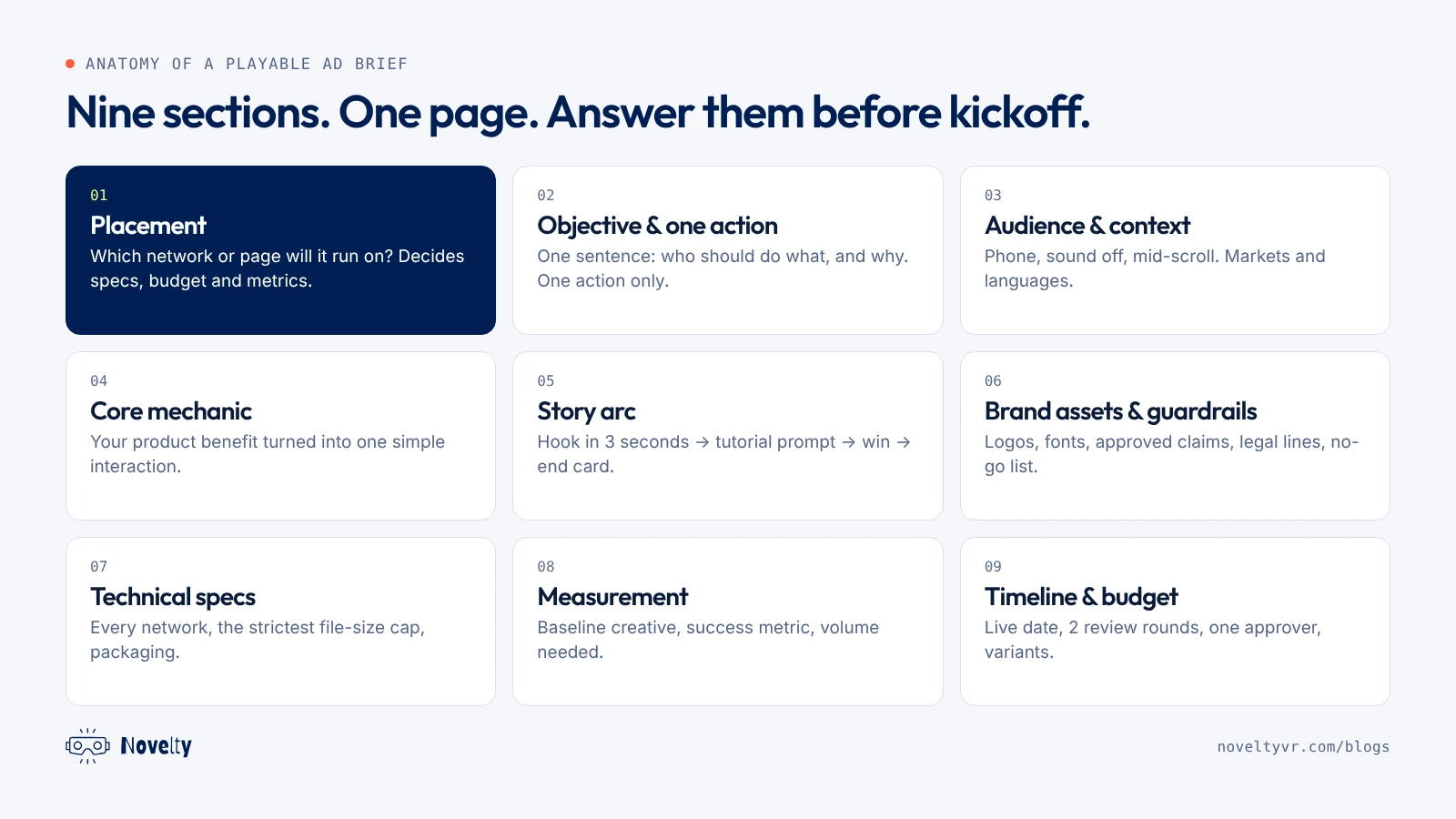
Quick answer: what goes into a playable ad brief? A useful brief settles nine things before any design work starts:
- Where the ad will run.
- The single action you want from the player.
- Who the audience is, and in what context they’ll see it.
- The one mechanic that shows your product’s benefit.
- The story arc, from hook to end card.
- Brand assets and legal guardrails.
- Technical specs for every network.
- How success will be measured.
- Timeline, review rounds and budget.
If the brief answers those, the agency can quote accurately and build the right thing the first time.
Step zero: decide where it will run (this changes everything)
“Playable ad” gets used for three different things, and they aren’t interchangeable.
- A true in-ad playable. A small HTML5 game that runs inside the ad unit on networks like AppLovin, Unity Ads, Mintegral or ironSource, or on Meta. These are built for app installs. Meta states it plainly: “Playable ads are only available with the App Installs objective.”
- An HTML5 interactive display ad. On Google Ads this is gated. Your account must have been open for more than 90 days, have more than US$9,000 in lifetime spend and have a good policy-compliance history before you can even apply.
- An ad that links to an interactive experience. A normal video or image ad whose click lands on a playable landing page or microsite. For brands without an app this is often the realistic route, and it isn’t limited by an ad unit’s file size.
These are different builds with different budgets, specs and metrics. When an agency brings us a brief, the first thing we check is the exact placement, because a playable that can’t legally run where the media plan says it will is the most expensive mistake on this list. Put the placement on the first line of your brief.
The nine sections of a playable ad brief
Placement is section one, covered above. Here is what the other eight should answer, and why the agency needs each.
Objective and the one action
Write a single sentence: “We want [audience] to [action] because [reason].” Install the app, start a free trial, try the product, leave an email. Pick one. A playable that asks someone to install, sign up and share is three ads competing in one 5 MB file.
Audience and viewing context
Who sees this, and where? Mostly on a phone, often with the sound off, usually in the middle of something else. Say whether the audience already plays games, whether they’ve seen your brand before, and which markets need localised text. Context decides how much explaining the playable can afford, which is usually close to none.
The core mechanic: your product benefit as an interaction
This is the heart of the brief, and the section most briefs leave blank. Don’t describe a game. Describe the product truth you want people to feel, and let the agency propose mechanics. “Our app makes splitting bills painless” might become a ten-second drag-to-split puzzle. “Our running shoe is light” might become a tap-to-sprint challenge.
Keep it to one mechanic. Meta’s own creative guidance is to keep the playable experience “extremely simple” and to end it “at a moment of high engagement.” Luna Labs recommends playables run “15–20 seconds or less.”
Story arc: hook, tutorial, win, call to action
Ask for the arc explicitly, because each beat has a job:
- Hook. Meta calls the first three seconds “the most important.” The first frame has to make sense with no instructions.
- Tutorial prompt. In AppAgent’s analysis, 85.4% of successful playables included tutorial prompts and logos. A hand icon showing where to tap beats a sentence of instructions.
- Payoff. 85.9% of completed top playables end in a win. Let people succeed, then ask.
- End card. One clear call to action. Only 55.1% of top playables had a strong on-screen CTA, which is an easy gap to close.
Brand assets and guardrails
List everything the team can use: logo files, fonts, colour codes, product renders, approved claims and required legal lines. Then list what’s off-limits, such as competitor references, certain colours, or claims legal hasn’t approved. Missing assets are the most common reason a two-week build slips to three.
Technical specs for every network
Name every network the playable will run on. Specs differ, and the build has to satisfy the strictest one. Most networks cap a playable at around 5 MB, but some are tighter, and nearly all require that the file makes no external network calls.
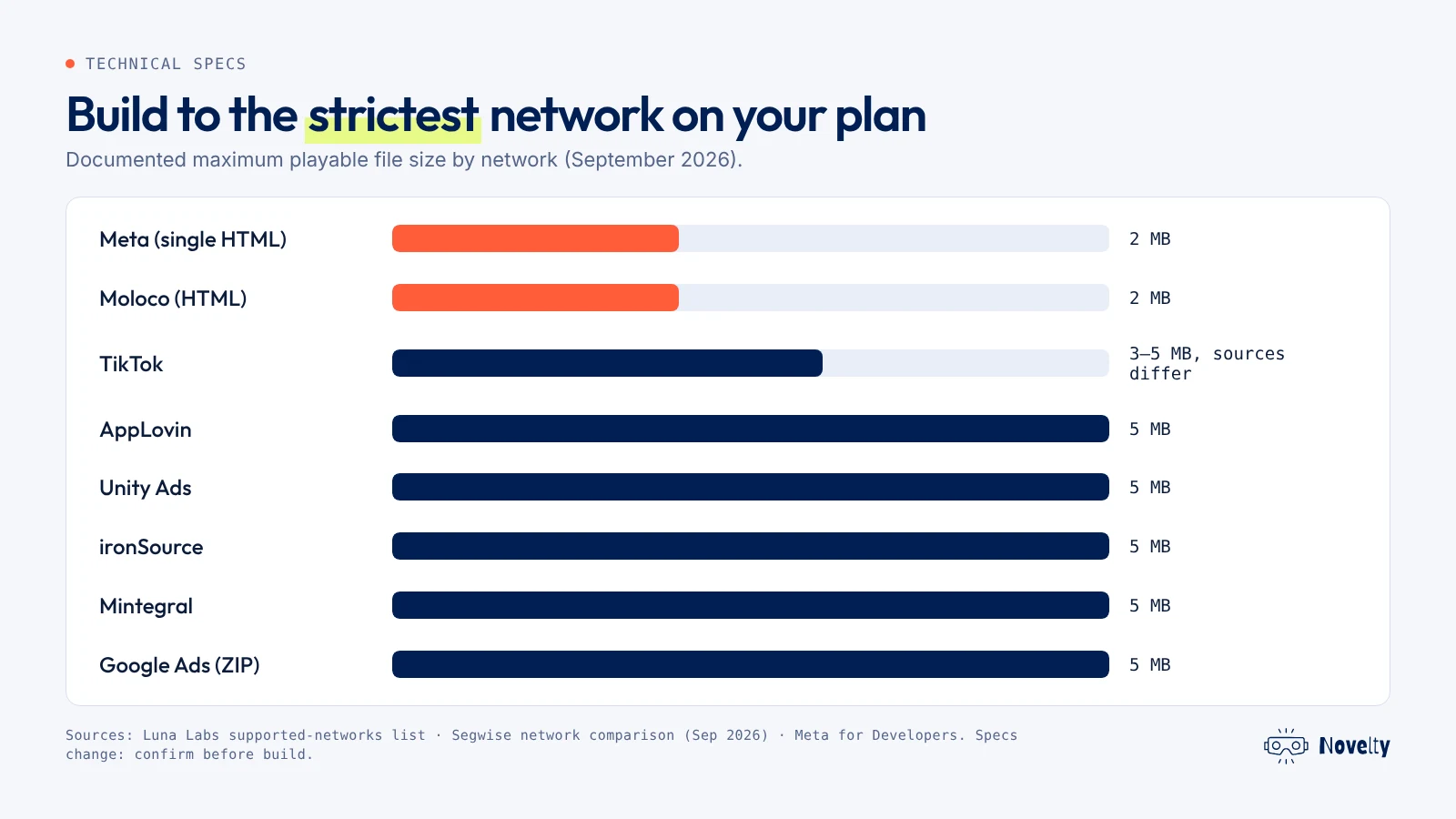
| Network | Documented size limit | Packaging |
|---|---|---|
| AppLovin | 5 MB | Single self-contained HTML file (MRAID 2.0) |
| Unity Ads | 5 MB | Single index.html, all assets inlined |
| ironSource | 5 MB | Single self-contained HTML file |
| Mintegral | 5 MB | Single HTML or ZIP (sources disagree) |
| Google Ads | 5 MB | ZIP (max 512 files), account eligibility required |
| Meta | 2 MB single HTML / 5 MB ZIP | Lead-in video required; App Installs objective only |
| Moloco | 2 MB HTML / 5 MB ZIP | Assets data-URI encoded, no external requests |
| TikTok | 3–5 MB (sources differ) | ZIP with index.html and config.json |
Compiled from Luna Labs’ supported-networks list, Segwise’s September 2026 network comparison and Meta’s developer documentation. Network specs change, so ask your agency to confirm against each network’s current documentation before the build starts.
Measurement: what “worked” means
Agree on the scoreboard before the build, not after. Typical metrics are interaction rate, completion rate, click-through from the end card, and then the downstream number that pays the bills: cost per install, cost per lead or purchase conversion. Name your baseline, usually the video or static creative currently running, and the volume you’ll need before calling a result. Playables are worth building when you can measure them against something.
Timeline, review rounds and approvals
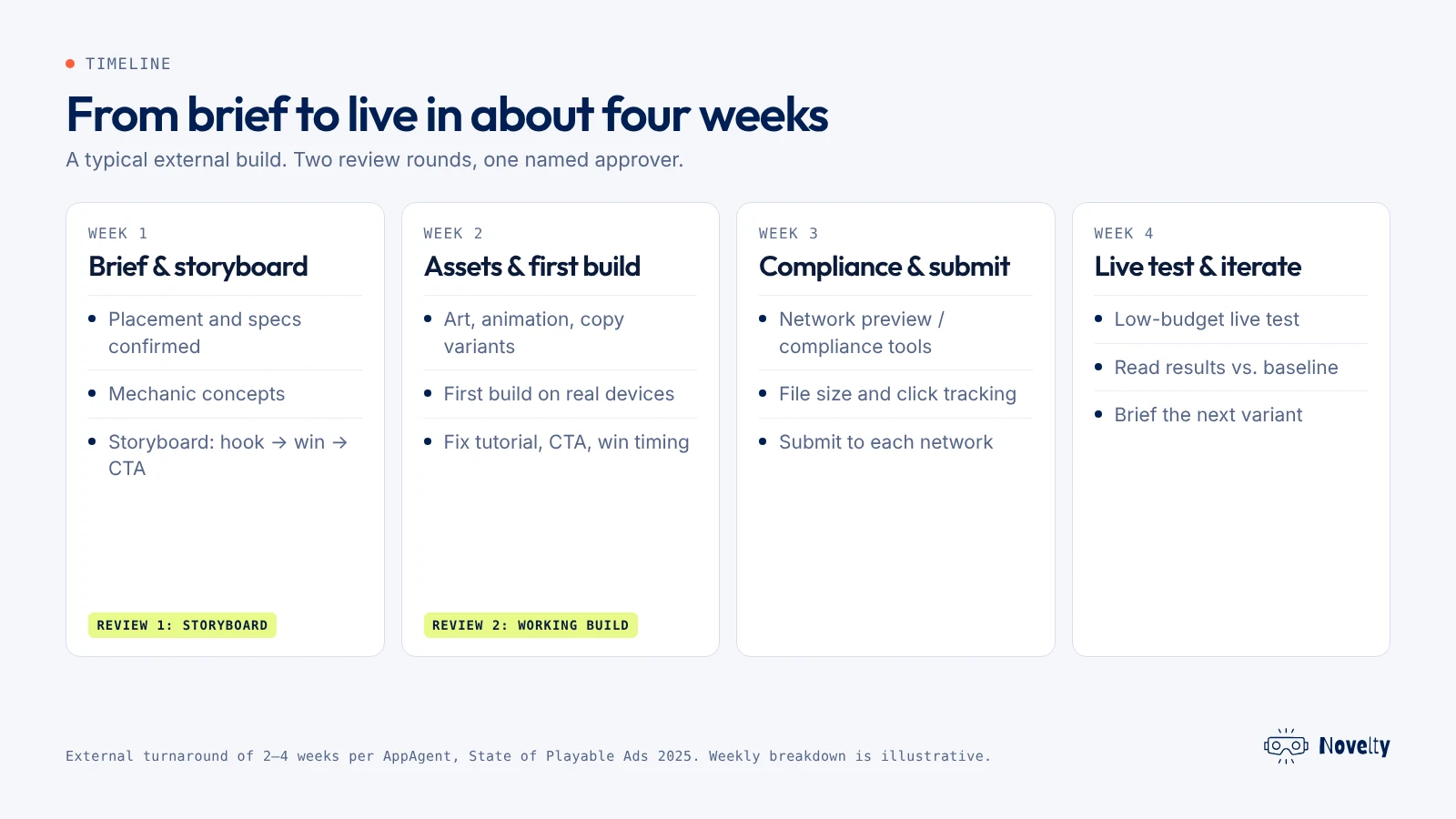
Give the live date and work backwards. A realistic external schedule is two to four weeks: concept and storyboard, asset production, a first build tested on real devices, then network compliance checks. We suggest writing two review rounds into the brief, one on the storyboard and one on the working build, and naming the one person who signs each off. Feedback by committee on a playable build is how two weeks becomes six.
Budget, variants and localisation
State the budget range, even roughly, so the agency can scope honestly. Say how many variants you want to test (different mechanics, different end cards) and how many languages. Variants are where playables earn their keep, and they’re far cheaper to plan for up front than to bolt on later. Our playable ads cost guide breaks down what moves the price.
What you should get back from the agency
A good playable ads agency should reply to your brief with:
- One or more mechanic concepts tied to your product truth.
- A storyboard of the hook, tutorial, payoff and end card.
- A timeline with the review points.
- A confirmed spec sheet per network.
- A clear handover list.
The handover should cover network-ready files for each placement, the tracking events, and source files if you’ve agreed to own them. If the reply doesn’t ask a single question about placement or measurement, treat that as a warning sign.
Five briefing mistakes we see most often
- No placement. The playable is built, then turns out not to be eligible for the planned channel.
- A game idea instead of a product truth. You get a fun game that doesn’t sell anything.
- Too many actions. Install, register and share, all in one ad.
- Specs discovered late. The build is reworked to fit a 2 MB cap after it was designed for 5 MB.
- No baseline. Nobody can say afterwards whether it beat the video.
If you’re still deciding whether playables suit your campaign at all, start with our complete guide to playable ads and these playable ad examples. If you’re an agency adding the format for clients, this piece on adding interactive experiences without hiring covers the partnership side.
Free template: the one-page playable ad brief
We’ve turned the nine sections into a one-page brief you can fill in and send to any agency, including us. It’s a plain PDF, with no email gate.
Download the playable ad brief template (PDF)
Frequently asked questions
How long does it take to build a playable ad?
For an external agency, two to four weeks is typical, according to AppAgent. Simple single-mechanic playables can be faster when assets are ready on day one. Late assets and unclear sign-off are the usual causes of delay.
How much does a playable ad cost?
AppAgent’s 2025 review puts typical external production at $3,000–$5,000 per playable. Complex, multi-scene or heavily custom builds cost more. See our cost guide for the full breakdown.
What is the file size limit for a playable ad?
Most networks document around 5 MB. Meta caps a single HTML file at 2 MB (5 MB as a ZIP), and some sources list TikTok at 3 MB. Build to the strictest network on your plan.
Can brands without an app use playable ads?
In-ad playables are mostly an app-install format, and on Meta they’re only available with the App Installs objective. Brands without an app usually get better results from an ad that links to an interactive landing page or microsite, which has none of the in-ad file limits.
How many revision rounds should a playable ad project include?
We recommend two: one on the storyboard before any build work, and one on the working build tested on real devices. More rounds usually signal an unclear brief rather than a better ad.
What should a playable ad handover include?
The handover should include network-ready files for each placement, confirmation that each passes the network’s preview or compliance tool, the list of tracked events, and source files if ownership was agreed in the contract.
The short version
A playable ad brief isn’t a longer creative brief. It’s a different document, because the thing being made is software. Settle where it runs, the one action, the one mechanic and the scoreboard, and most of the risk disappears before a single sprite is drawn.
If you’d like a second pair of eyes on a brief before it goes out, book a free consultation. We’ll tell you honestly whether a playable is the right format for the placement you have.
Sources
- AppAgent, “The State of Playable Ads in 2025: Mid-Year Strategic Review” (6 August 2025): appagent.com
- Meta for Developers, “Playable Ads for Mobile Apps”: developers.facebook.com
- Meta for Developers, click-to-play ads creative guidance: developers.facebook.com
- Google Ads policy, “About restricted ad formats and features” (HTML5 eligibility): support.google.com
- Luna Labs, “Supported ad networks”: knowledge.lunalabs.io
- Luna Labs, “Best practices for interactive ads”: knowledge.lunalabs.io
- Segwise, “Playable Ad Specs: Every Major Network Compared (2026)” (18 September 2026): segwise.ai