
A brand comes to an agency with a brief that used to be simple: a landing page, a video, a media plan. Now it includes a line like “we want something people can actually play with” or “our last activation felt flat, we need something more interactive this time.” The account lead nods in the meeting. Then walks back to the studio and asks the obvious question: who on this team can actually build that?
Usually, nobody can. Not because the agency lacks talent, but because building a playable ad, a gamified landing page, or a 3D product configurator requires a completely different skill set than the one most agencies hired for. It sits closer to game development than to graphic design or copywriting. That gap is exactly why more shops are quietly turning themselves into an interactive marketing agency without adding a single new hire, and it’s showing up in more briefs every quarter, not fewer.
The squeeze agencies are actually feeling
Two things are true about agencies right now, and they pull in opposite directions.
The first is that production work, the part of the business that used to fill timesheets, is getting harder to charge for. More than 80% of ANA member advertisers now run some form of in-house agency, according to the ANA’s 2023 in-house agency census, and that number has only grown since. Brands that once outsourced everything now keep routine content, paid media execution, and basic creative in-house, and only bring agencies in for what they genuinely can’t do themselves.
The second is that when agencies do get client relationship surveys back, “the work itself” tends to rank far below things like strategic judgment and business understanding as a driver of client satisfaction and retention. Clients aren’t paying agencies to be a production line anymore. They’re paying for judgment, and for access to capabilities they don’t have internally.
Put those two facts together and the strategic move becomes obvious: agencies need to hold onto (or build) the capabilities that are genuinely hard to replicate in-house, and stop competing on the ones that aren’t. Interactive and immersive production (playable ads, gamified experiences, WebXR, 3D configurators) sits firmly in the “hard to replicate” column. We’ve written before about what interactive marketing technology actually covers, but the short version is: almost no brand has a Unity developer on staff. Most agencies don’t either.
Why “just hire someone” doesn’t actually solve this
The instinct, when a capability gap shows up often enough, is to hire for it. For interactive production, that instinct usually backfires, for three reasons.
The skill is narrow, but the need is lumpy. One playable ad campaign or one interactive microsite doesn’t justify a full-time real-time developer, and the work doesn’t arrive on a predictable schedule. You’d be paying a specialist’s salary to sit idle between projects, which is exactly the utilization problem agencies are already trying to avoid on the production side.
One hire isn’t a bench. Interactive projects touch several disciplines at once: game design and interaction logic, 3D or WebGL rendering, UX for something that isn’t a static page, and increasingly AI for personalization or avatars. A single generalist hire can prototype something simple. They can’t reliably deliver a client-facing campaign on a deadline without backup.
The tooling and pipeline take longer to build than the first project allows. Real-time engines, asset pipelines, hosting for interactive builds, QA across devices: none of that exists on day one of a new hire’s first sprint. Agencies that try to stand this up from scratch usually burn their margin on the first two or three projects just getting the pipeline working, before they’ve proven the capability is worth keeping.
Three real paths, and where each one breaks
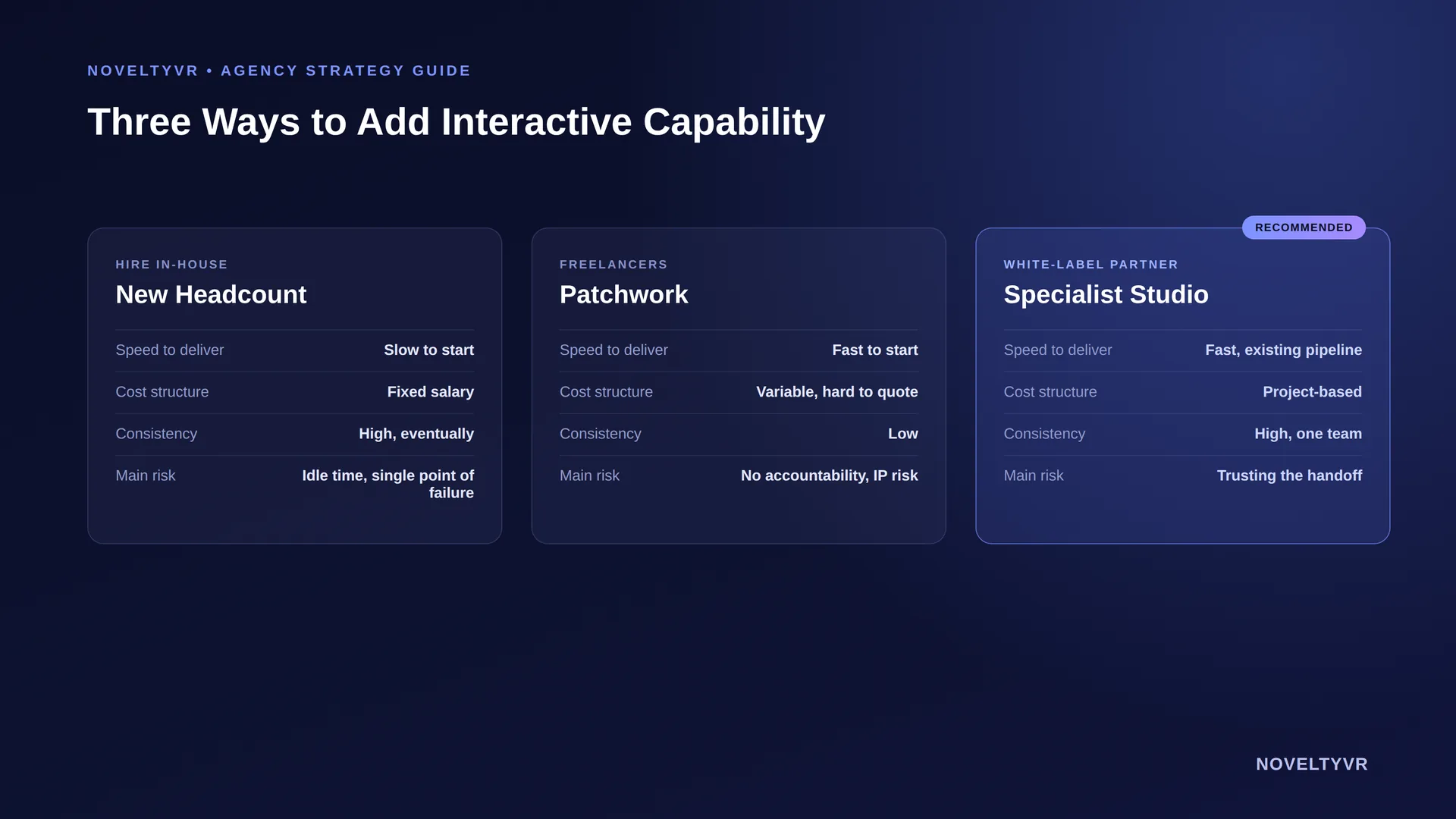
Once an agency accepts it needs the capability but shouldn’t build a department around it, there are really three options on the table. Here’s how they compare in practice.
| Approach | Speed to first delivery | Cost structure | Consistency across projects | Where it breaks |
|---|---|---|---|---|
| Hire in-house | Slow: hiring, onboarding, pipeline setup before the first brief | Fixed salary cost regardless of project volume | High, once established | Idle time between projects; single point of failure if the hire leaves |
| Patchwork freelancers | Fast to start, unpredictable to finish | Variable, but hard to quote reliably upfront | Low; quality and process shift with every freelancer | No accountability for the finished product; IP and handoff risk; agency still manages the project directly |
| White-label technology partner | Fast, using an existing pipeline and team | Project-based, scales with actual demand | High; one team, repeatable process | Requires trusting an outside team with the client relationship’s execution layer |
Most agencies default to the freelancer patchwork first, mainly because it feels lower-commitment than either of the other two options. It’s usually the most expensive path in practice — not in day rate, but in the account lead’s time spent managing scope, chasing revisions, and explaining to the client why the interactive build looks different in quality from everything else the agency ships.
What a white-label interactive technology partner actually is
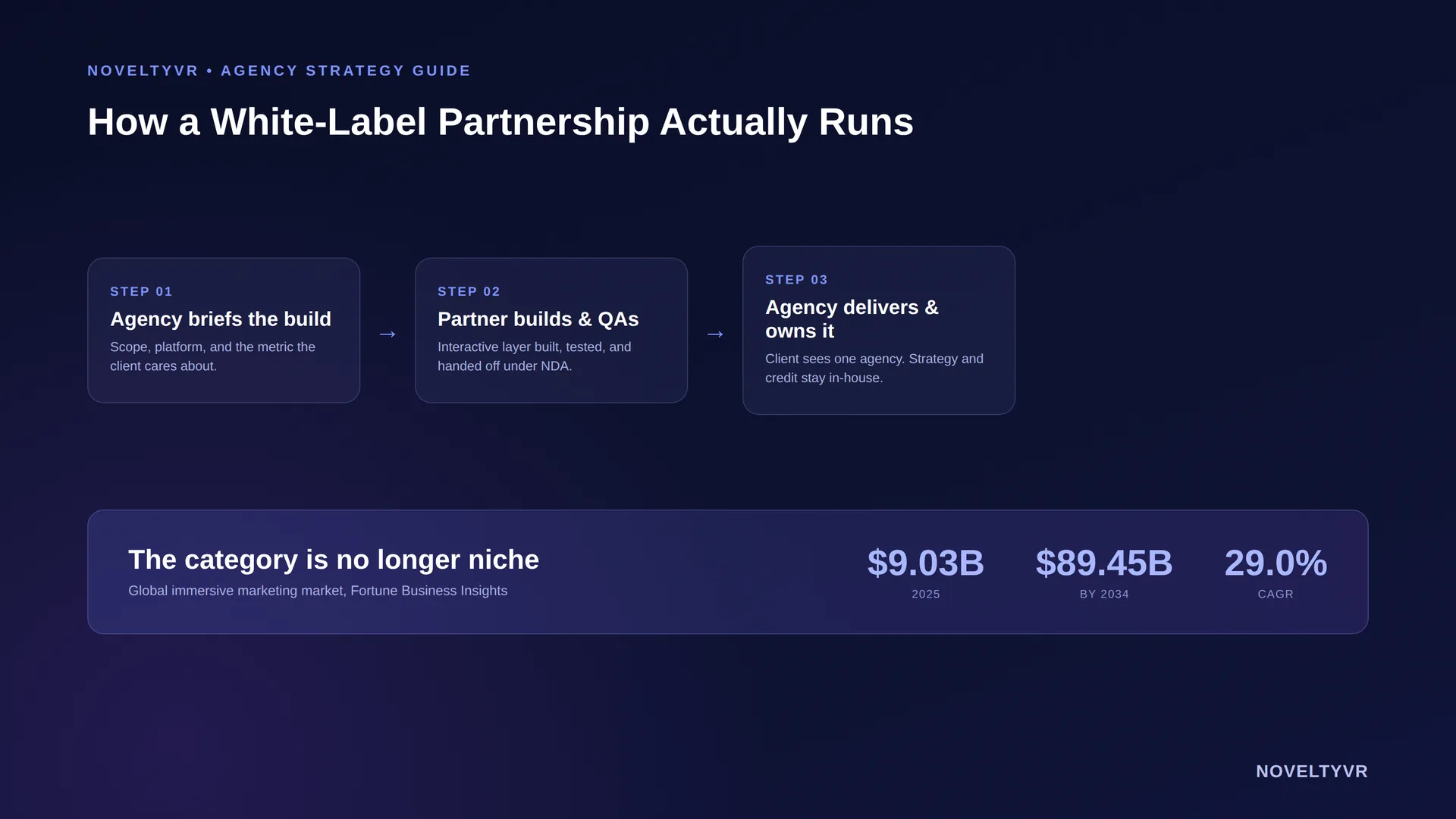
The term gets thrown around loosely, so it’s worth being precise. A white-label interactive technology partner is a specialist studio that designs and builds the interactive or immersive component of a campaign (the playable ad, the configurator, the WebXR experience, the gamified microsite) while the agency of record keeps the client relationship, the strategy, the media plan, and the brand.
The client sees one agency. Internally, the interactive build runs through a team that does nothing else. That’s the entire value proposition: the agency gets a specialist capability without absorbing a specialist’s overhead, hiring risk, or idle-time cost.
This is different from a general dev shop or a freelance marketplace in one important way: the partner is built specifically for agency workflows. NDA by default, agency branding on deliverables, tight production timelines, and a process built around briefs rather than long discovery cycles. NoveltyVR runs this way for exactly this reason; agencies bring us the brief, we build the interactive layer, and the credit for the finished campaign stays with the agency.
What it actually takes to offer this, in practice
Agencies considering this route usually ask a more specific version of the question: what do we actually need in place to start offering playable ads or interactive microsites to clients? The honest answer is less than most expect.
- A clear scope template. Interactive builds go sideways when the brief is vague. A one-page scope covering platform (mobile, web, both), interaction type, and the metric the client cares about avoids most of the back-and-forth.
- A realistic production timeline. A single playable ad or interactive landing page typically takes 3–4 weeks from signed brief to delivery with an experienced partner. A brand game, configurator, or gamified lead-gen mechanic can run longer depending on complexity. Set client expectations against that reality, not against a static banner’s turnaround time.
- A QA and handoff process. Interactive builds need testing across devices and browsers before they go live, and a clear technical handoff — hosting, embed code, analytics events — so the agency’s media team can actually run the campaign once it’s built.
- A pricing model that isn’t hourly. Because the underlying partner is charging per project, not per hour, agencies that mark up on a flat project basis (rather than trying to reverse-engineer an hourly rate) tend to have cleaner, less contentious client conversations.
None of that requires new headcount. It requires a template, a partner, and one internal owner (usually whoever already runs production traffic) who knows the process well enough to brief it correctly.
Pitching it to the client without over-promising
The pitch that works isn’t “we now do VR.” It’s much narrower, and much more credible: showing, not telling. A rough playable ad prototype, or even a simple gamified mockup, communicates more in a pitch meeting than three slides describing what an interactive experience could look like. Agencies that build this into the pitch process, rather than the delivery process, tend to close more of these briefs, because the client is reacting to something real instead of imagining a description.
It also helps to be specific about the “why,” not just the “what.” Interactive formats consistently hold attention longer than passive formats. We broke down the actual engagement gap between interactive, video, and static ad formats in a separate data comparison, and it’s the entire premise behind why brands are asking for these formats in the first place. But the agency’s job in the pitch is to connect that to something the client’s business actually measures: lead quality, time-on-page, configurator-driven average order value, or campaign recall. The technology is the mechanism. The business outcome is the pitch.
The category isn’t niche anymore
It’s worth sizing this honestly. The global immersive marketing market was valued at roughly $9.03 billion in 2025 and is projected to reach $11.66 billion in 2026, growing toward $89.45 billion by 2034: a compound annual growth rate of just over 29%, according to Fortune Business Insights. That’s not a niche experiment anymore. It’s a category brands are actively budgeting for, and the agencies that can credibly say yes when a client asks for it are the ones capturing that spend, not the ones building the capability from a standing start after the brief has already landed on a competitor’s desk.
Frequently asked questions
How can marketing agencies add interactive experiences to their services without hiring?
By partnering with a white-label interactive technology studio that builds the playable ad, microsite, or immersive experience under the agency’s brand, while the agency keeps the client relationship, strategy, and media execution in-house.
What do agencies need in place to offer playable ads to clients?
A clear scope template, a realistic production timeline (typically 3–4 weeks for a straightforward build), a QA and technical handoff process, a flat project-based pricing model, and a reliable production partner. No in-house developer is required to start.
What is a white-label interactive technology partner?
A specialist studio that designs and builds interactive or immersive marketing assets (playable ads, configurators, WebXR experiences, gamified microsites) for agencies to deliver to their own clients under the agency’s brand, without the agency needing in-house production capability.
How do agencies pitch interactive experiences to brand clients?
The strongest pitches lead with a working prototype rather than a description, and tie the format to a business metric the client already tracks — lead quality, dwell time, or conversion — rather than presenting the technology as the headline.
Where to start
None of this requires an agency to bet on a new department, a new hire, or a new tool stack before it has a client brief to justify it. The agencies moving fastest here are treating interactive capability the same way they’d treat any specialist production need, the way video editing or 3D rendering used to be handled, by partnering with a team that already does it well and keeping the relationship, the strategy, and the credit where it belongs: with the agency.
If your agency has a brief sitting in the “we don’t know how to build this” pile, that’s usually the easiest place to start. Talk to us about what a white-label build would look like for that specific project. Most agencies know within one conversation whether the fit makes sense.