
Open any marketing deck built in the last two years and you’ll find the word “engagement” on nearly every slide. Rarely does anyone define it. Fewer still can measure it honestly. Impressions get counted, clicks get counted, but the thing everyone actually wants — a person who stopped, paid attention, and remembers what they saw — keeps slipping through the reporting.
That gap is exactly why interactive marketing technology has moved from “interesting experiment” to “line item in the budget” for agencies and brand teams alike. It isn’t a single tool or a single ad format. It’s a category of technology built on one premise: people engage with things they can act on, not just things placed in front of them.
This guide breaks down what interactive marketing technology actually is, how it differs from the terms it constantly gets confused with, what the category includes today, and how brands and agencies are putting it to work.
The Short Answer
Interactive marketing technology is any digital tool, platform, or experience that requires an audience to take an action — play, click, configure, answer, explore — in order to receive the marketing message, rather than simply consuming it. It includes playable ads, gamified campaigns, 3D product configurators, AR and VR experiences, AI-driven avatars, and interactive landing pages.
The defining trait isn’t the technology stack underneath it. WebGL, Unity, or a simple JavaScript quiz can all qualify. What matters is the structure of the exchange: the brand offers something worth participating in, and the audience gets something back — entertainment, personalization, utility, or a small win — for engaging with it.
Why This Is Happening Now
None of this is new in theory. Interactive ads have existed since Flash banners let you play mini-golf inside a rectangle in 2003. What’s changed is the economics.
Attention has gotten more expensive at almost exactly the rate that consumers have gotten better at ignoring ads. The average person is exposed to more sponsored content in a single scroll session than they were in a full day a decade ago, and the brain has adapted the only way it can: by filtering harder. A banner ad, a 15-second pre-roll, a static product photo — these formats ask for attention without offering anything for it. Increasingly, that ask goes unanswered.
Interactive formats flip the transaction. According to research aggregated by content platform vendors and cited across the industry, interactive content consistently outperforms static content on the metrics that actually predict business outcomes — not just view counts. Industry benchmarking on interactive content puts average engagement gains around 50% higher than static formats, with time spent nearly 1.5x longer. Separate research on gamification in marketing has tied game-like mechanics to meaningfully higher conversion rates when applied to lead forms and onboarding flows, and to stronger repeat engagement when applied to loyalty programs.
None of these numbers mean every interactive experience automatically outperforms every ad. A poorly designed quiz converts worse than a great video. But directionally, the pattern is consistent enough that performance marketers, not just creative teams, have started asking for it by name.
The Interactive Marketing Technology Stack
“Interactive marketing technology” is an umbrella term. Underneath it sits a growing toolkit that brands and agencies mix and match depending on the goal — awareness, lead generation, conversion, or retention.
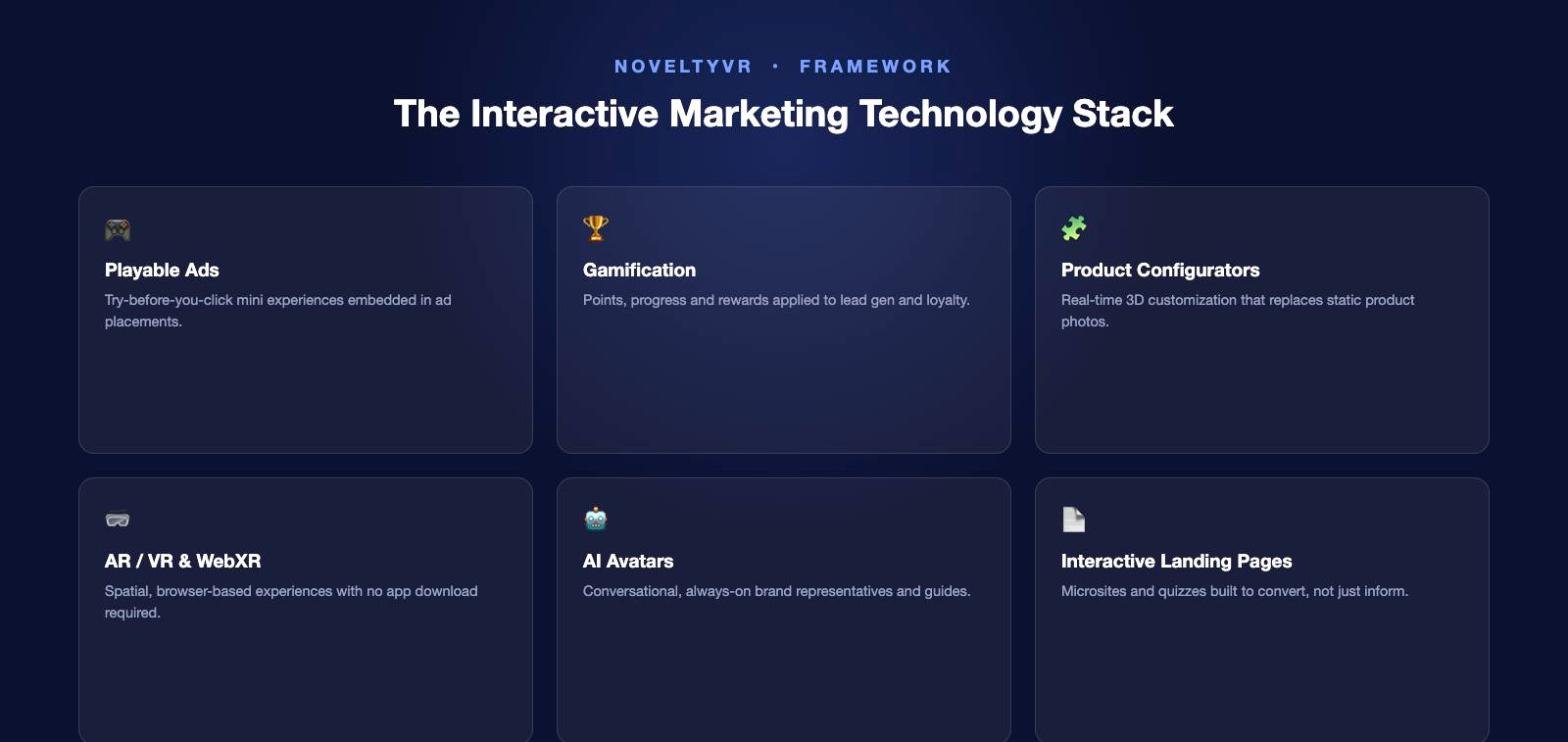
Playable Ads
A playable ad embeds a short, functional mini-game or interactive demo directly inside an ad unit. Instead of describing a mobile game or a product feature, the ad lets someone try it — for ten to thirty seconds — before deciding whether to tap through. Mobile gaming popularized the format, but retail, fintech, and automotive brands now use the same mechanic to let people “test drive” a product inside the ad itself.
Gamification
Gamification applies game mechanics — points, streaks, progress bars, unlockable rewards, leaderboards — to marketing touchpoints that aren’t games at all: lead capture forms, onboarding flows, loyalty programs, email sign-ups. Done well, it turns a transactional moment (“fill out this form”) into a small, low-stakes contest people actually want to finish.
Product Configurators
A 3D or web-based configurator lets a customer build, customize, and rotate a product in real time — choosing colors, materials, or components and seeing the result immediately. Automotive and furniture brands were early adopters; the same technology now shows up in fashion, consumer electronics, and B2B equipment sales, largely because it replaces a static photo gallery with something closer to an in-person showroom.
AR and VR / WebXR
Augmented reality lets someone place a product in their own physical space through a phone camera. Virtual and web-based XR experiences go further, placing the user inside a fully built environment — a virtual showroom, a branded world, a training simulation. WebXR specifically means this runs directly in a browser, with no app download required, which has quietly removed the single biggest adoption barrier immersive marketing used to have.
AI Avatars
AI-driven avatars combine conversational AI with a visual, often animated, brand presence — a guide who can answer product questions, walk a visitor through a demo, or qualify a lead in natural language instead of a static FAQ page or a chat widget with canned responses.
Interactive Landing Pages
Beyond a scrolling page of copy, interactive landing pages use quizzes, calculators, branching content, or embedded configurators to qualify and segment visitors while they browse — turning a page that used to just inform into one that also collects first-party data.
Interactive vs. Experiential vs. Immersive Marketing
These three terms get used almost interchangeably in marketing conversations, and that’s a problem, because they aren’t the same thing and they don’t solve the same problem.
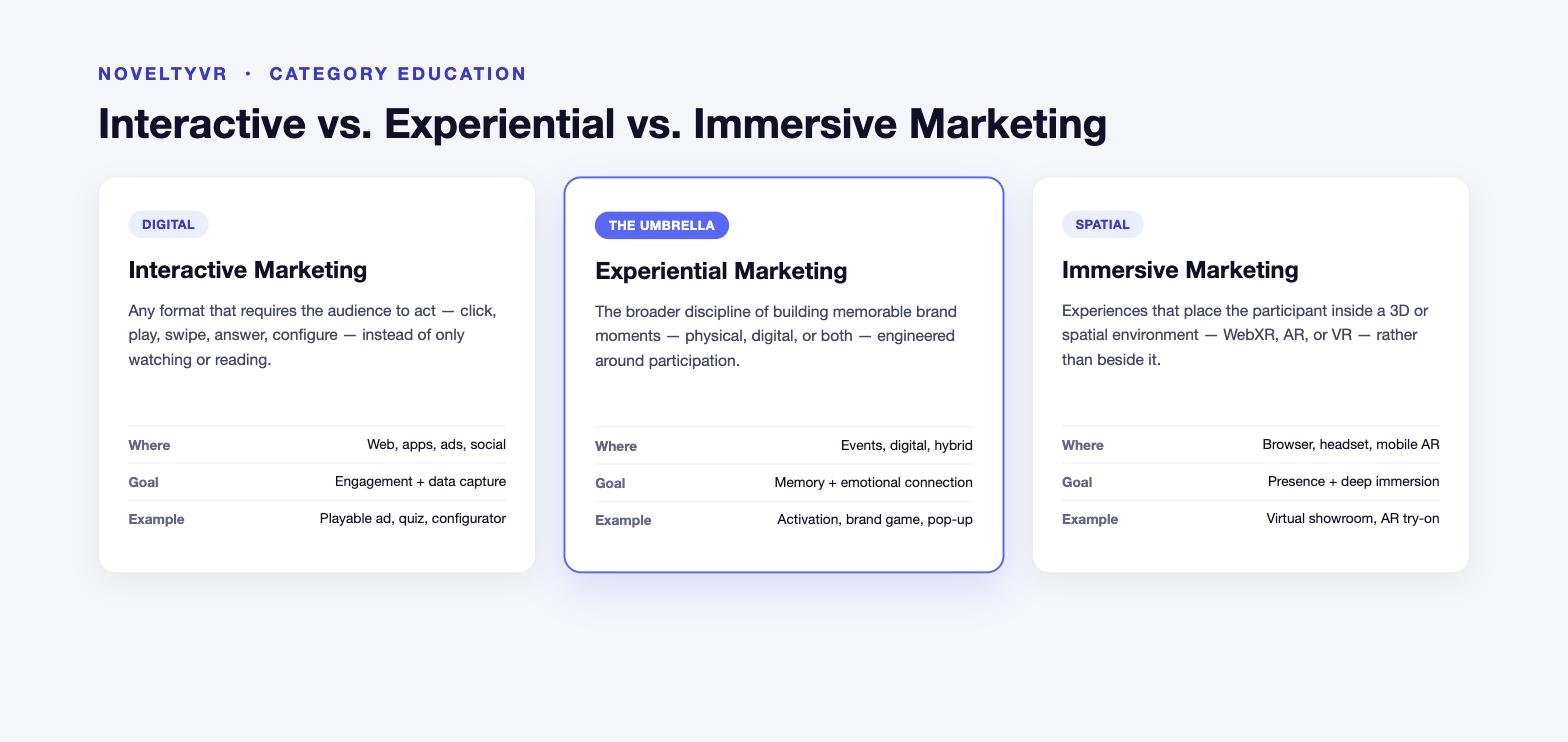
| Term | What it means | Primary goal | Typical example |
|---|---|---|---|
| Interactive Marketing | Any format requiring the audience to act, digitally, instead of just viewing | Engagement and first-party data capture | Playable ad, quiz, configurator |
| Experiential Marketing | The broader discipline of building memorable brand moments, physical or digital | Emotional connection and memory | Live activation, branded game, pop-up |
| Immersive Marketing | Experiences that place the participant inside a 3D or spatial environment | Presence and deep engagement | Virtual showroom, AR try-on |
Think of experiential marketing as the parent category — the broad goal of making a brand memorable through participation, whether that happens at a live event, on a website, or in an app. Interactive marketing is the specific subset of that discipline built with digital tools, designed to scale to thousands of people at once rather than the few hundred who can attend an activation. Immersive marketing is a further subset of interactive marketing, defined specifically by spatial presence: AR, VR, and WebXR experiences that put someone inside the environment rather than in front of a screen looking at it.
The practical implication: a brand doesn’t have to choose one. The strongest campaigns typically combine an experiential goal — “make people remember us” — with interactive execution — “using formats people can act on” — and, where relevant, immersive technology to deepen the effect further.
What “Participatory Marketing” Actually Means
You’ll also see the phrase “participatory marketing” used alongside interactive marketing, and it’s worth clarifying because the distinction matters strategically. Participatory marketing describes campaigns where the audience doesn’t just interact with brand-made content — they help create it. User-generated content campaigns, co-creation contests, and customizable products that get shared publicly are participatory in this sense.
Interactive marketing technology is often the infrastructure that makes participatory marketing possible at scale. A configurator that lets someone design a product and then share the result is both interactive (they had to act) and participatory (what they created becomes part of the campaign). The categories overlap constantly, but interactive marketing technology is the broader, more technical term — the tools and systems — while participatory marketing describes a specific strategic outcome those tools can produce.
The Business Case, in Plain Terms
Strip away the format names and the pitch to a CMO or a client is straightforward: interactive experiences tend to hold attention longer, convert better, and generate first-party data that passive content simply cannot.
On the mobile advertising side, Liftoff’s Mobile Ad Creative Index — one of the more frequently cited industry benchmarks — found that playable ads were roughly 20 times more likely to drive installs than banner ads in gaming apps, while also costing less per install than native ad formats in the same study. That gap exists because a playable ad self-selects: someone who plays a ten-second demo and continues has already shown real intent, which is a fundamentally different signal than a click driven by curiosity or misdirection.
On the conversion side, gamified lead forms and onboarding flows are regularly reported to outperform standard forms by wide margins, and multiple independent write-ups on interactive content report conversion lifts in the range of two to five times over static equivalents, depending on format and execution quality. The honest caveat: these figures come from vendor and industry aggregator studies rather than a single controlled academic dataset, so treat them as directional evidence of a real pattern rather than a guarantee for any specific campaign.
The more durable argument, independent of any single statistic, is about data. A static banner tells you almost nothing about the person who saw it. A configurator, a quiz, or a playable ad tells you what someone chose, how far they got, and where they dropped off — first-party signal that has become significantly more valuable as third-party cookies and ad tracking keep eroding.
Who’s Actually Using This
Two groups drive most of the current adoption, and they have different reasons for doing it.
Brand and performance marketers adopt interactive formats because their existing channels are showing diminishing returns. Video completion rates are falling, ad blockers are widespread, and privacy changes have made retargeting less precise. Interactive formats offer a way to both capture attention and rebuild a first-party data pipeline in the same motion.
Marketing and creative agencies adopt it for a different reason: differentiation. When every agency pitch includes a paid media plan, a content calendar, and a brand refresh, those services have become commodities. An agency that can walk into a pitch with a working interactive prototype — something the client can click through in the room — is competing on a completely different axis than one showing static mockups. This is also why white-label interactive technology partnerships between agencies and specialist studios have grown: agencies get the differentiation without building an in-house engineering team.
How to Start, Without Overbuilding
The most common mistake brands make with interactive marketing technology is treating it as a single, expensive, all-or-nothing project — a fully custom VR experience with a six-month timeline. That’s rarely the right entry point.
- Start with the funnel stage that’s already leaking. If a landing page has traffic but weak conversion, an interactive quiz or configurator addresses that directly. If ad creative is fatiguing quickly, a playable ad format is the more targeted fix.
- Match the format to the buying decision. High-consideration, high-price products (cars, furniture, real estate) benefit most from configurators and immersive walkthroughs. Impulse and mid-consideration products often see faster wins from gamified offers and playable ads.
- Build once, deploy across channels. A well-built interactive experience can live on a landing page, get embedded in an ad, and get shared on social — one build, multiple distribution points.
- Measure participation, not just impressions. Completion rate, time-in-experience, and choices made are better leading indicators of quality than raw view count.
Agencies without in-house Unity or WebGL engineers typically don’t build this from scratch — they partner with a specialist studio that can turn a brief into a working prototype in weeks rather than months, and white-label the delivery under the agency’s own name.
Frequently Asked Questions
What is interactive marketing technology?
Interactive marketing technology is the category of tools and platforms — playable ads, gamification, product configurators, AR/VR and WebXR, AI avatars, and interactive landing pages — that require an audience to take an action to engage with a marketing message, rather than passively consuming it.
What is the difference between experiential and interactive marketing?
Experiential marketing is the broader discipline of creating memorable, participation-driven brand moments, whether at a live event or online. Interactive marketing is the digital subset of that discipline, built specifically with technology that scales to large audiences.
What is the difference between interactive and immersive marketing?
Immersive marketing is a subset of interactive marketing focused specifically on spatial experiences — AR, VR, and WebXR — where the participant is placed inside a 3D environment. Interactive marketing is the wider category that also includes non-spatial formats like quizzes, playable ads, and configurators.
What does “participatory marketing” mean?
Participatory marketing describes campaigns where the audience helps create the content or outcome, not just engage with it — for example, a shareable product configuration or a user-generated content campaign. Interactive marketing technology is often the infrastructure that makes participatory marketing possible at scale.
What’s the difference between a brand game and a playable ad?
A playable ad is a short interactive demo embedded inside a paid ad placement, usually 10–30 seconds, designed to drive a click or install. A brand game is typically a standalone, longer-form interactive experience hosted on a brand’s own site or microsite, designed for engagement and shareability rather than direct ad conversion.
Do I need an app to use AR or VR marketing?
No. WebXR technology allows AR and VR experiences to run directly inside a mobile or desktop browser, with no app download required — which has removed one of the biggest adoption barriers immersive marketing used to face.
The Takeaway
Interactive marketing technology isn’t a trend that’s arriving — it’s already the baseline expectation in categories where brands compete for considered purchases. The question for most marketing teams isn’t whether to adopt it, but where to start: which funnel stage needs it most, and which format matches the decision the customer is actually making.
At NoveltyVR, this is the entire premise of the work: building playable ads, gamified campaigns, configurators, and WebXR experiences for brands and agencies who want to stop competing for attention and start earning participation. If you want to see what an interactive experience feels like before committing to one, the fastest way is to try it yourself.
Pingback: Become an Interactive Marketing Agency Without Hiring
Pingback: 5 Interactive Marketing Examples With Real Results (2026)