
Search for interactive marketing examples and you’ll find the same headline over and over: some brand “doubled conversions” with a quiz, a try-on or a game. Then you click through, and the number has no source, the brand has no name, or the campaign turns out to be a mock-up.
We wanted a list we could defend. So we set one rule: every example below names a real brand, describes what customers actually did, and points to where the number came from. That rule cut a long list down to five. It also changed the story. The honest headline isn’t “interactive marketing doubles conversions”. It’s that letting people do something before they buy has moved real numbers for very different brands, and the way it worked is consistent enough to copy.
Quick answer: what are good examples of interactive marketing? Five with published results:
- Rebecca Minkoff: 3D and AR product views. AR viewers were 65% more likely to buy.
- Macy’s: VR furniture planning in store. VR-influenced furniture sales rose more than 60%, with returns under 2%.
- Burger King Brazil: “Burn That Ad”, an AR app feature. One million downloads in a month and a 54.6% rise in in-app sales.
- Jones Road Beauty: a product quiz that became its best-performing paid landing page.
- L’Oréal: AR make-up try-on, which its chief digital officer said triples conversion rates.
Each one turns a passive page or ad into something the customer does, and each answers a specific doubt that was stopping the sale.
What counts as interactive marketing?
Interactive marketing is any campaign or experience where the audience takes an action that changes what they see: trying a product on, spinning it in 3D, answering questions that shape a recommendation, playing a short game. The difference from ordinary content is simple. A video plays the same way for everyone. An interactive experience responds. It overlaps with interactive content marketing (quizzes, calculators, assessments), but it also covers ads, product pages and physical spaces.
That matters commercially because a response is a signal. When someone picks a shade or places a sofa in their living room, you learn what they want, and they learn whether the product fits. If you want the longer version of the category, our guide to interactive marketing technology covers the formats in detail.
The five examples at a glance
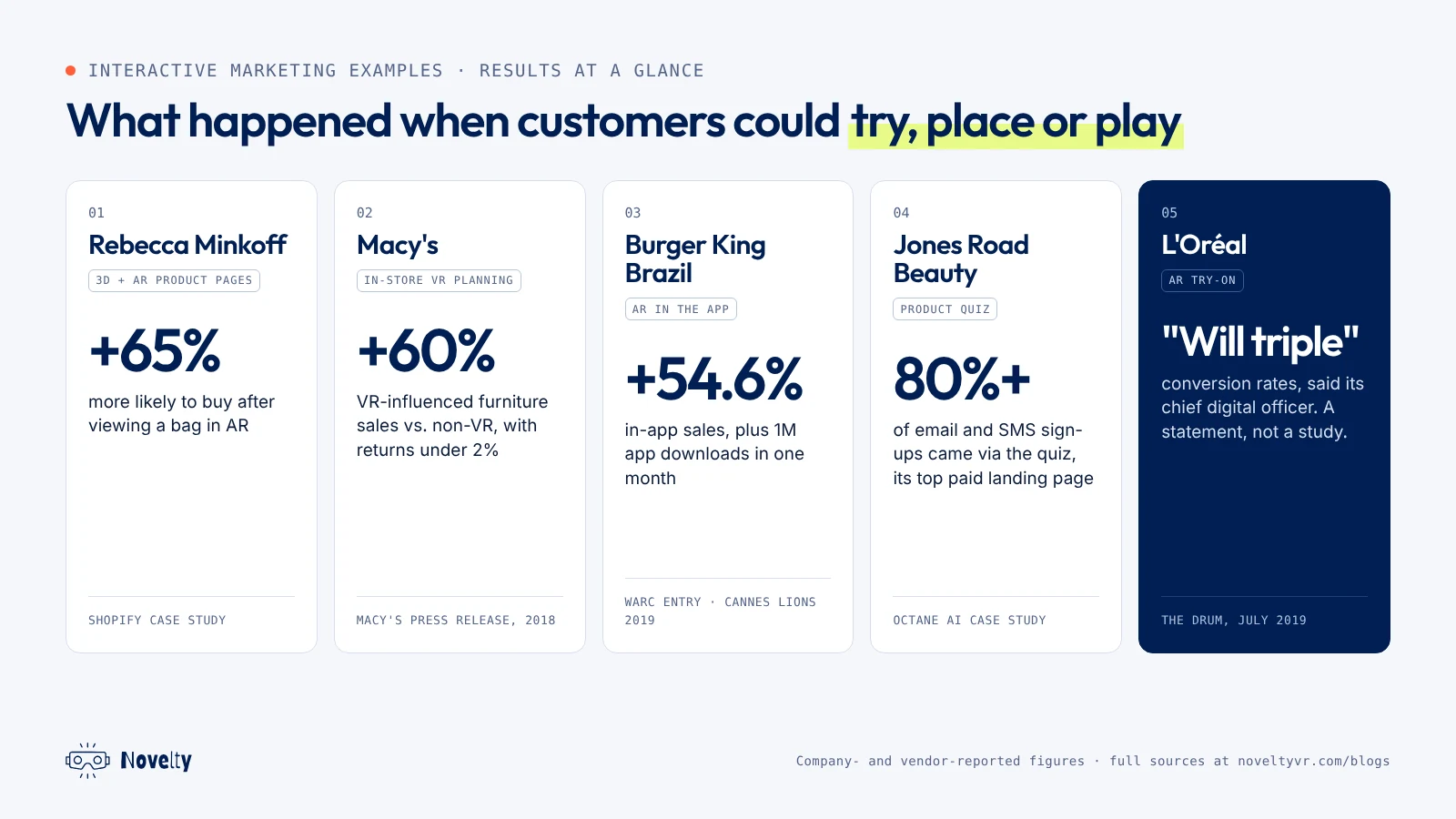
| Brand | Format | What customers did | Reported result | Where the number comes from |
|---|---|---|---|---|
| Rebecca Minkoff | 3D models + AR | Rotated bags in 3D, placed them in AR | 65% more likely to buy after AR view | Shopify case study |
| Macy’s | In-store VR | Designed a room and placed furniture in VR | 60%+ higher sales vs. non-VR; returns under 2% | Macy’s press release (2018) |
| Burger King Brazil | AR in the brand app | “Burned” rival ads to unlock a free Whopper | 1M downloads in a month; +54.6% in-app sales | WARC campaign entry; Cannes Lions 2019 |
| Jones Road Beauty | Product quiz | Answered questions to find their shade and products | Top paid landing page; 80%+ of email/SMS sign-ups | Octane AI case study |
| L’Oréal | AR virtual try-on | Tried make-up on their own face | “Conversion rates will triple” (executive statement) | The Drum interview (2019) |
1. Rebecca Minkoff: letting shoppers hold the bag before they buy it
A handbag photo tells you colour and style. It doesn’t tell you whether the bag is bigger than you thought, or how it will look against your coat. That gap is a classic reason people hesitate online.
Rebecca Minkoff added 3D models and augmented reality to more than 50 product pages, so shoppers could rotate a bag on screen or place it in the room in front of them. According to Shopify’s case study, shoppers who interacted with a 3D model were 44% more likely to add the item to their cart and 27% more likely to place an order. Those who viewed a product in AR were 65% more likely to buy.
One caution worth stating plainly: these compare shoppers who chose to interact with those who didn’t. People who bother to spin a bag are often keener to begin with. The lift is real for the brand, but it isn’t a controlled test of the feature alone. Shopify’s own platform data points the same way at a larger scale. In May 2022 it said merchants who add 3D content to their stores see a 94% conversion lift on average.
The lesson: interaction works best when it settles a specific doubt. Here the doubt was size and presence, and 3D answered it better than any extra photo.
2. Macy’s: selling furniture to people who can’t picture their room
Furniture has a brutal version of the same problem. Will this sofa fit? Will it look right next to everything else? Customers who guess wrong send it back, and furniture returns are expensive.
In 2018 Macy’s put virtual reality furniture planning into its stores. Shoppers could lay out a room to their own dimensions and walk around it with a headset before buying. In the three-store pilot, Macy’s reported that VR-influenced furniture sales rose more than 60% compared with non-VR furniture sales, and the return rate on those purchases was under 2%. The results were strong enough that Macy’s expanded the experience to around 90 stores.
The lesson: the payoff isn’t only the first sale. An experience that helps people choose correctly also cuts the cost of them choosing wrong. Today the same idea runs in a browser, with no headset or store visit needed.
3. Burger King Brazil: turning a rival’s ads into a coupon
This one is less about removing doubt and more about giving people a reason to act right now.
In “Burn That Ad”, created by David São Paulo, Burger King’s app let people in Brazil point their phone at a competitor’s ad. Augmented reality set the ad on fire on screen, and burning it unlocked a free Whopper in the app. The campaign won a Gold Lion in Direct at Cannes in 2019. Its WARC campaign entry reports one million app downloads in a month and a 54.6% increase in in-app sales.
As with most award entries, those figures are reported by the brand and agency rather than audited by a third party. But the structure is the interesting part. The interaction wasn’t a gimmick sitting beside the offer. Playing was the path to the offer, and the offer lived inside the app Burger King wanted people to install.
The lesson: put the reward at the end of the interaction, and put the interaction inside the channel you want people to adopt. Playable ads use the same logic, which is why we collected ten playable ad examples that work on this principle.
4. Jones Road Beauty: a quiz that does the job of a sales assistant
Shade matching is where online beauty sales go to die. Customers aren’t sure which foundation or tint suits them, so they don’t buy, or they buy and return.
Jones Road Beauty built a product quiz that asks a few questions about skin and preferences, then recommends specific shades and products. According to its case study with quiz platform Octane AI, the quiz became the brand’s top-performing landing page for paid acquisition, and more than 80% of its email and SMS subscribers came through it. The case study credits the quiz as instrumental in the brand passing $100 million in revenue.
Two honest caveats. The case study is published by the software vendor, and it doesn’t give a conversion rate for the quiz against a standard product page. What it does show is where the brand chose to send its paid traffic, which is a decision companies usually make on results.
The lesson: a quiz earns attention by giving something back immediately, a personal answer, and the brand gets first-party data in return. If you’re weighing quiz-style lead capture, our study of gamified versus standard lead forms looks at what the benchmark data supports.
5. L’Oréal: virtual try-on at global scale
L’Oréal acquired the augmented reality company ModiFace in 2018 and rolled virtual make-up try-on across its brands and retail partners. Customers can test a lipstick or hair colour on their own face through a phone camera before they buy.
In a 2019 interview with The Drum, L’Oréal’s then chief digital officer Lubomira Rochet said that when the brand adds AR try-on to a website or app, “conversion rates will triple” and engagement time on the site doubles. That is the biggest number on this list, and it deserves the most care: it’s an executive’s statement, not a published study, and The Drum noted she was cautious about sharing detailed results.
We include it anyway because the direction matches everything else here, and because a company of L’Oréal’s size kept investing in the technology for years afterwards. Companies don’t usually do that with a feature that doesn’t sell.
The lesson: try-on works because it replaces the step customers miss most when they shop online, testing the product on themselves.
The pattern behind all five
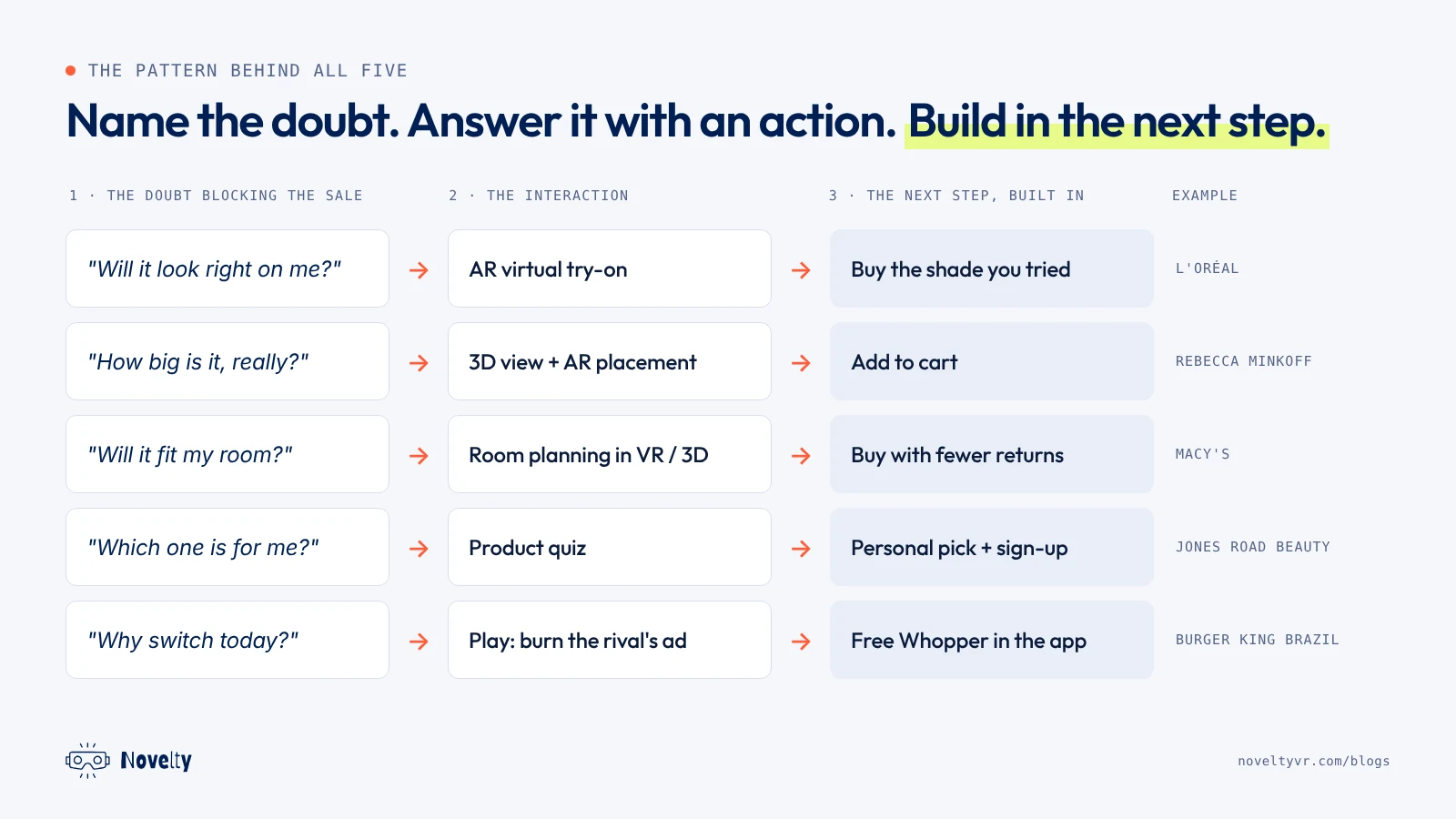
Three of the five are AR marketing examples, but the format matters less than the job it does. Put the five side by side and the same three-part structure shows up every time.
- A specific doubt was blocking the sale. Will it look right on me? How big is it? Will it fit my room? Which one is mine? Why should I switch?
- The interaction answered that doubt directly. Not a game for its own sake, but try-on for appearance, 3D for size, room planning for fit, a quiz for choice, a reward for switching.
- The next step was built into the experience. Add to cart after the AR view. A recommendation with a buy button. A coupon inside the app. Nobody had to leave the experience to act on it.
This is also the clearest way to decide whether an interactive format belongs in your next campaign. If you can’t name the doubt it removes, it’s decoration. If you can, you have a hypothesis you can test.
If you can’t name the doubt an interaction removes, it’s decoration. If you can, you have a test.
Does interactive marketing really double conversions?
Sometimes it gets close. Shopify’s platform figure of a 94% lift for merchants who add 3D content is a near-doubling, and Snap has reported that campaigns using its product try-on Lenses were twice as likely to drive a statistically significant lift in what it calls Action Intent, people’s stated intent to act, such as buying. But no reliable source we found shows a guaranteed 2x, and most published numbers share two weaknesses:
- They come from people who sell the technology (Shopify, Snap, quiz platforms) or from brands and agencies entering awards.
- They compare self-selected users. Shoppers who choose to interact are often already more interested, which inflates the gap.
None of that makes the results fake. It means the right expectation is “a meaningful lift worth testing”, not “double your conversions”. The way to know for your own brand is to measure it properly: send a share of traffic to the interactive version and the rest to your current page, keep everything else equal, and compare conversion rate and revenue per visitor rather than clicks.
How to apply this to your next campaign
Start with the doubt, not the technology. Here’s a quick map from the most common buying hesitations to the formats that answer them:
| The customer is asking… | Format that answers it | Example above |
|---|---|---|
| “Will it look right on me?” | AR try-on | L’Oréal |
| “How big is it, really?” | 3D product view, AR placement | Rebecca Minkoff |
| “Will it fit my space?” | 3D configurator, WebXR room view | Macy’s |
| “Which one is right for me?” | Quiz or interactive product finder | Jones Road Beauty |
| “Why should I act now?” | Playable ad or game with a reward | Burger King |
Then keep the first version small. Pick one product, one placement and one metric with a baseline you already track. A pilot like that tells you more than a large launch with no control group, and it costs far less to get wrong.
If you’d like to feel the difference before planning anything, our interactive demos let you try a product finder with a static/interactive toggle, a 3D configurator, a WebXR room view and three playable ad mechanics. They use fictional brands and prove what the formats can do, not what your campaign will return. For agencies adding these formats for clients, we’ve written about offering interactive work without hiring a team.
Key takeaways
- The strongest interactive marketing examples remove a specific buying doubt: fit, size, shade, choice or motivation.
- Published results are real but mostly self-reported or vendor-reported, so treat them as reasons to test, not promises.
- The closest documented “doubling” is Shopify’s 94% average lift for merchants that add 3D content.
- Build the next step into the experience. The best examples never make customers leave to act.
- Pilot small, against a baseline, and judge it on conversions and revenue rather than engagement alone.
Frequently asked questions
What are some examples of interactive marketing?
Common examples include AR virtual try-on (L’Oréal), 3D and AR product views (Rebecca Minkoff), VR or 3D room planning (Macy’s), product quizzes (Jones Road Beauty), playable ads and branded games, interactive landing pages, product configurators and AR campaigns such as Burger King’s “Burn That Ad”.
Does interactive marketing increase conversions?
Published cases show meaningful lifts, for example Rebecca Minkoff’s AR viewers being 65% more likely to buy and Macy’s VR-influenced furniture sales rising more than 60%. Most of these figures are company-reported and compare users who chose to interact, so the reliable way to know is an A/B test on your own traffic.
What is the difference between interactive and experiential marketing?
Experiential marketing usually means live, physical brand experiences such as events and pop-ups. Interactive marketing covers any experience where the audience’s actions change what they see, and it increasingly runs digitally in browsers, apps and ads. The two overlap when a physical activation has a digital interactive layer.
How do you measure the ROI of interactive marketing?
Compare the interactive experience against your current page or ad with a split test. Track conversion rate, revenue per visitor and, where relevant, return rate, alongside engagement metrics like completion rate and time spent. Engagement alone isn’t ROI.
Is interactive marketing only for big brands?
No. Quizzes, product finders and lightweight 3D views can be built for a single product or campaign, and browser-based formats need no app download. Starting with one product and one metric keeps cost and risk low.
The bottom line
Interactive marketing doesn’t win because it’s novel. It wins when it gives customers a way to answer the question that was stopping them from buying, and then puts the next step within reach. The five brands here did that in very different ways, from a burning rival ad to a shade quiz. Find the doubt in your own funnel, pick the format that answers it, and test it against what you have now.
Want help working out which interactive format fits your next campaign? Book a free consultation with the NoveltyVR team.
Sources
- Shopify, “Rebecca Minkoff” case study: shopify.com/case-studies/rebecca-minkoff
- Shopify Changelog, “Shop adds 3D and augmented reality (AR) previews”, 11 May 2022: changelog.shopify.com
- Retail Dive, “Macy’s expanding VR furniture shopping to 90 stores by January”, 17 Oct 2018: retaildive.com
- WARC, “Burger King: Burn That Ad” campaign entry: warc.com
- Contagious, “Cannes Lions Direct winners 2019”: contagious.com
- Octane AI, “Jones Road Beauty” case study: octaneai.com
- The Drum, “Conversion rates triple when L’Oréal uses AR tech to showcase products”, 2 Jul 2019: thedrum.com
- Social Media Today, “Snapchat shares new research into how AR campaigns are driving conversion”, 6 Jul 2021: socialmediatoday.com