Ask a marketing team to define “engagement” and you’ll get a dozen different answers. Ask them to define “gamification” and most will reach for the same three examples: Starbucks Rewards, Duolingo’s streak, and a spin-to-win email popup. That’s the problem. Gamification has been reduced to a handful of familiar tricks, when it’s actually a structured way of using game mechanics — points, progress, competition, reward uncertainty — to change what people do, not just how they feel about a brand.
Used narrowly, it’s a popup. Used properly, gamification in marketing becomes a system that can lift lead capture, session time, and repeat purchase rate in ways a static page or a one-off promotion can’t.
The Short Answer
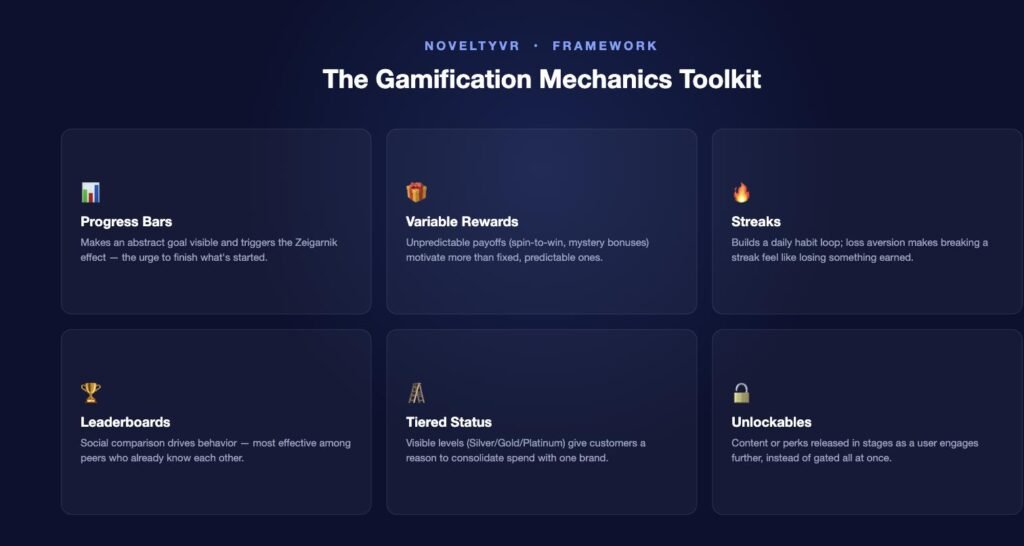
Gamification in marketing is the application of game-design mechanics — points, levels, streaks, leaderboards, progress bars, variable rewards — to non-game marketing experiences like landing pages, loyalty programs, onboarding flows, and lead forms. It works because these mechanics tap into well-documented behavioral psychology: people complete things they’ve already started (the Zeigarnik effect), they respond more to unpredictable rewards than fixed ones (variable reward scheduling), and they change behavior faster when progress is visible than when it isn’t.
The businesses getting real ROI from it aren’t the ones adding a badge to a website. They’re the ones designing the mechanic around a specific business outcome — more qualified leads, higher repeat purchase rate, faster onboarding completion — and building the system to measure it.
What Gamification in Marketing Actually Means
Gamification in marketing is not the same thing as game-based marketing. Game-based marketing means building an actual game — a branded mini-game, a playable ad, an interactive experience someone plays for its own sake. Gamification means borrowing the mechanics of games and applying them to something that isn’t a game at all: a checkout flow, a loyalty tier, an email subject line, a sales dashboard.
The distinction matters because it changes where you apply it. You don’t need to build a game to gamify a lead form. You need a mechanic: a progress bar showing how close someone is to a reward, a spin-to-win wheel that replaces a static discount code field, a set of unlockable tiers in place of a flat loyalty program.
Why It Works: The Psychology Behind the Mechanics
Three behavioral principles show up again and again in gamified marketing, and understanding them is more useful than memorizing a list of tactics.
Variable reward scheduling. B.F. Skinner’s research on operant conditioning found that unpredictable rewards produce stronger, more persistent behavior than predictable ones. This is why a spin-to-win wheel outperforms a flat “10% off” code, even when the average discount is identical — the uncertainty itself is motivating.
The Zeigarnik effect. People remember and want to complete unfinished tasks more than finished ones. A progress bar at “80% complete” creates psychological tension that a blank form field never does. This is the same mechanic behind LinkedIn’s profile-completion meter and Duolingo’s streak counter.
Loss aversion and streaks. Once someone has built a streak, ending it feels like a loss, not just a missed opportunity. Loss aversion is a stronger motivator than the prospect of an equivalent gain, which is why streak-based mechanics tend to outperform simple point-accumulation systems for retention.
None of this is exotic. It’s the same psychology behind loyalty punch cards from decades ago. What’s changed is that digital experiences can track, personalize, and reward this behavior in real time, at a level a paper card never could.
Leaderboards: The Mechanic Everyone Underestimates
Leaderboards get dismissed as a gimmick for sales teams and fitness apps, but the underlying mechanic — visible, ranked comparison against peers — is one of the more reliable engagement levers when it’s used with the right audience. Social comparison theory, the psychological basis for leaderboards, holds that people evaluate their own standing by comparing themselves to others, and that this comparison changes behavior even when there’s no tangible prize attached.
The mechanic works best in three specific situations: sales and channel partner programs, where reps or partners are already competitive by nature; referral and advocacy programs, where visible rank motivates continued sharing; and community-driven products, where users interact with each other and status is genuinely meaningful. It works poorly in cold acquisition contexts, where there’s no existing relationship or peer group to compare against — a leaderboard shown to a first-time website visitor has nothing to anchor to, and tends to fall flat.
The design detail that matters most is showing people their position relative to others close to them, not just the top of the leaderboard. Someone in 47th place has no motivation looking at a top-10 list. Someone who can see they’re two spots from 40th has a concrete, achievable target.
Where Gamification Actually Moves Numbers
The clearest use cases fall into four categories, and each has a different job to do.
Lead generation
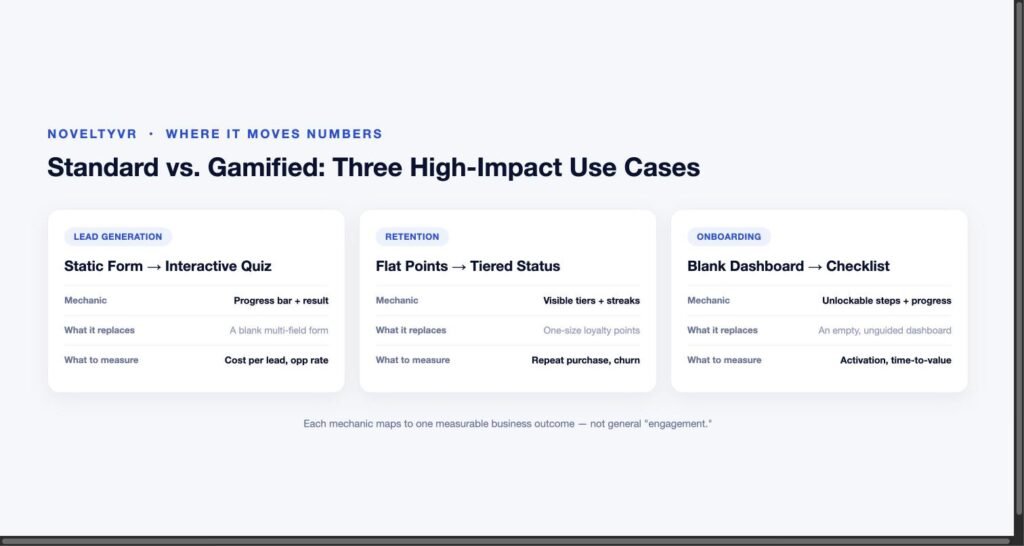
Gamified quizzes, assessments, and “spin to reveal your offer” mechanics are commonly reported to convert at meaningfully higher rates than static forms — largely because the mechanic front-loads a small commitment (answering a question, spinning a wheel) before asking for contact information, rather than asking for it cold. Progress bars on multi-step forms follow the same logic: showing someone they’re most of the way through a form measurably increases completion versus an unmarked form of identical length.
Loyalty and retention
Tiered loyalty programs with visible progress — “you’re 200 points from Gold status” — consistently outperform flat point-accumulation programs on repeat purchase rate. Starbucks’ rewards app is the most cited example of this in the industry: its tiered, gamified structure is widely credited with helping drive a meaningfully higher visit frequency among app users compared to non-members. Sephora’s Beauty Insider program follows the same tiered logic — visible status levels (Insider, VIB, Rouge) tied to spend, which gives customers a reason to consolidate purchases with one brand rather than split them across competitors just to protect their tier. Duolingo has been even more direct about the mechanic’s impact — leadership has publicly credited the streak feature as one of the most important levers in scaling the company’s user base.
Onboarding and activation
SaaS products use progress checklists and unlockable features to move new users through activation faster. The mechanic isn’t decoration — it’s a way of making an abstract goal (“get value from this product”) into a concrete, visible sequence of steps.
Email and campaign engagement
Adding a game-like element to an email — a scratch-off reveal, a countdown-based unlock, a personalized progress update — is one of the more reliable ways to lift open and click-through rates above a brand’s own baseline, because it interrupts the pattern of a normal promotional email.
What a Gamified Sales Funnel Actually Looks Like
A gamified sales funnel doesn’t replace the standard awareness-consideration-decision structure — it adds mechanics at the friction points where prospects typically drop off. At the top, an interactive assessment or quiz replaces a static lead magnet, trading a downloadable PDF for a personalized result that requires a few seconds of participation before it delivers value. In the middle, unlockable content — a deeper report, a benchmark comparison, a calculator result — is released in stages as a prospect engages further, rather than gated entirely behind one form.
At the bottom of the funnel, the mechanic shifts from participation to status: a “you qualify for X tier of pricing” reveal, a countdown-based incentive, or a visible comparison against a benchmark the prospect just generated themselves. The common thread across all three stages is that the mechanic produces a personalized result specific to that prospect, rather than showing the same static content to everyone — generic gamification (a spinning wheel with the same five outcomes for every visitor) has a much shorter shelf life than gamification that incorporates the visitor’s own inputs.
B2B teams tend to get more mileage from this style of funnel than from consumer-style prize mechanics, because the “reward” in a B2B context is usually information relevant to a real decision — a benchmark, a personalized audit, a cost estimate — not a discount code.
How to Calculate ROI for a Gamified Campaign
The mistake most teams make is measuring vanity engagement — time on page, quiz completions, spins — instead of the business metric the mechanic was built to move. A working ROI framework ties the mechanic to one of three outcomes:
For lead generation: compare cost per lead and lead-to-opportunity conversion rate between the gamified experience and your existing form or landing page, over the same traffic source and time window.
For retention and loyalty: compare repeat purchase rate, average order frequency, and churn between customers enrolled in the gamified program and a comparable cohort that isn’t — not just before-and-after, since seasonality and other campaigns will contaminate a simple before/after read.
For onboarding: compare activation rate and time-to-first-value between users who go through the gamified flow and those who don’t, ideally via an A/B test rather than a full rollout, so you can isolate the mechanic’s effect.
If a gamification initiative can’t be tied to one of these three, it’s decoration, not strategy — and it’s worth asking, before building anything, which one it’s supposed to move.
Common Mistakes That Undercut Gamification Campaigns
The mechanic gets blamed for problems that are actually strategy problems. The most common failure patterns:
Rewarding the wrong action. A points system that rewards logins instead of purchases optimizes for the wrong behavior — you’ll get more logins and no more revenue.
No clear reward structure. If users can’t tell what they’re working toward or how close they are, the Zeigarnik effect never kicks in. Ambiguous progress is the same as no progress.
Treating it as a one-time campaign. A spin-to-win popup that runs for two weeks and disappears builds no habit. The mechanics that move retention numbers — streaks, tiers, unlockables — require sustained presence, not a campaign burst.
Skipping the mobile experience. Most gamified interactions — spinning a wheel, checking a streak, viewing a progress bar — happen on a phone. A mechanic that’s clunky on mobile loses most of its psychological effect, because friction cancels out the reward loop it’s trying to create.
Gamification and Customer Lifetime Value
The connection between gamification and lifetime value runs through frequency, not just individual purchase size. A customer who checks a loyalty app weekly to track streak or tier progress is, by definition, engaging with the brand more often than one who receives an occasional email. That increased contact frequency is what tends to move lifetime value — not the mechanic itself, but the habit it builds. This is also why gamification aimed purely at one-time acquisition (a giveaway, a single spin-to-win) rarely shows up in LTV numbers the way an ongoing tiered program does — there’s no habit loop to sustain the relationship after the initial reward.
A Practical Way to Get Started
Teams that get gamification right tend to follow roughly the same sequence, regardless of industry.
They start by naming the single business metric the mechanic needs to move — not “engagement,” but a specific number: cost per lead, repeat purchase rate within 90 days, onboarding completion rate. Vague goals produce vague mechanics.
They pick one mechanic and one channel to pilot, rather than gamifying the entire customer journey at once. A single gamified landing page tested against the existing page, on the same traffic source, is enough to prove or disprove the concept before any larger investment.
They build in measurement from day one — the comparison group, the tracking, the time window — rather than launching first and figuring out how to measure success afterward. Retrofitting measurement onto a live campaign almost always produces a weaker, less trustworthy result than planning it upfront.
And they treat the first version as a starting point, not a finished product. The mechanics that perform best in the examples above — Starbucks’ tiers, Duolingo’s streak — were refined over years of iteration based on real user behavior, not shipped once and left alone.
What Skills This Actually Requires
Marketing teams underestimate how many disciplines a well-built gamified experience actually touches. It’s not just a design problem or a copywriting problem — a mechanic that’s genuinely effective usually needs behavioral/psychology thinking to choose the right mechanic for the right audience, interaction design to make the mechanic feel smooth rather than clunky (especially on mobile), backend integration so points, streaks, and unlocks persist and connect to a CRM or loyalty system rather than resetting every session, and analytics instrumentation built in from the start so the campaign can actually be measured against the business metric it was meant to move.
Most internal marketing teams have some of these skills in-house and are missing at least one — usually the interaction design and backend integration pieces, since those sit closer to product development than traditional marketing execution.
Do You Need an Agency — or a Plugin?
Most marketing teams’ first instinct is to bolt on a spin-to-win plugin or a third-party quiz tool. For a simple, single-purpose mechanic, that’s often the right call — no need to overbuild.
The gap shows up when the mechanic needs to feel like part of the brand rather than a bolted-on widget, when it needs to connect to a CRM or loyalty backend rather than run standalone, or when the mechanic itself needs to be genuinely novel rather than a template every competitor is also using. That’s a production problem closer to building a small interactive product than installing a plugin, and it’s where most internal marketing teams and traditional agencies don’t have the right skill set on staff — which is exactly the gap studios built around interactive experience design, including ours, exist to close.
Frequently Asked Questions
What’s the difference between gamification and game-based marketing?
Gamification applies game mechanics (points, progress, rewards) to non-game experiences like forms and loyalty programs. Game-based marketing means building an actual playable experience, like a branded mini-game or playable ad, that people engage with as entertainment in its own right.
What are the best examples of gamification in marketing?
Starbucks Rewards (tiered loyalty with visible progress), Duolingo (streaks), and gamified quiz-based lead forms in ecommerce are among the most frequently cited examples, precisely because each ties a specific mechanic to a specific business outcome rather than adding gamification for its own sake.
How does gamification affect customer retention?
Primarily through habit formation. Streaks and tiered progress give customers a reason to return on a predictable cadence, and loss aversion makes them reluctant to let that streak or status lapse — which is a stronger retention lever than a generic “come back” email.
Is gamification worth it for B2B marketing?
Yes, though the mechanics look different. B2B gamification tends to show up in gated content unlocks, interactive assessments and calculators, and account-based progress tracking rather than consumer-style spin wheels — the psychology is the same, but the format matches a longer, more considered buying process.
Do progress bars really increase completion rates?
Yes — this is one of the more consistently replicated findings in the space, and it’s the direct product of the Zeigarnik effect described earlier. The effect is strongest when the bar reflects genuine progress rather than an arbitrary animation; a progress bar that jumps forward without a real reason behind it tends to be noticed and discounted by users fairly quickly.
The Takeaway
Gamification in marketing works when it’s built around a specific behavior a business actually needs — more qualified leads, higher repeat purchase rate, faster onboarding — and fails when it’s added as decoration. The mechanics themselves (progress, variable reward, streaks, tiers) are well understood and backed by real behavioral research. The differentiator isn’t knowing the mechanics exist; it’s designing the right one for the right outcome, and building it well enough that it feels native to the brand rather than bolted on.