
Somewhere around the third year of every marketer’s career, they figure out an uncomfortable truth: people do not want to watch your ad. They will skip it, mute it, scroll past it, or let their thumb do the thinking before their brain even registers what was on screen. Eyetracking studies have been proving this since before “banner blindness” had a name.
Playable ads are one of the few formats that gets around this problem — not by shouting louder, but by asking the viewer to do something instead of just look at something. Tap a fruit. Steer a car around a corner. Drag a shoe onto a foot. It sounds almost too simple to matter, and yet the format has quietly become one of the highest-performing units in digital advertising, with reported conversion lifts as high as 319% over standard video creative.
This guide is the one we wish existed when we started building these things: no fluff, no recycled definitions, just a straight answer to what playable ads are, how they actually work under the hood, what they cost, where they’re headed in 2026, and how to brief one without wasting six weeks and a chunk of your media budget on a version that doesn’t perform.
A quick word on where this comes from: we build interactive marketing technology for a living — playable ads, gamified microsites, 3D configurators — for agencies and brands who need something a static banner can’t do. Everything below is written from that vantage point, cross-checked against current industry data.
Table of Contents
- What Is a Playable Ad?
- How Do Playable Ads Actually Work?
- Playable Ads vs. Video Ads vs. Static Ads: The Data
- Why the Format Outperforms
- Real Examples of Playable Ads Done Well
- Where Playable Ads Run: Platforms and Specs
- What Do Playable Ads Cost in 2026?
- Beyond Gaming: Ecommerce, Finance & FMCG
- How AI Is Changing Playable Ad Production
- Common Mistakes That Kill Performance
- How to Brief or Choose a Playable Ad Partner
- FAQ
- Key Takeaways
- Conclusion
1. What Is a Playable Ad?
A playable ad is a short, interactive advertisement that lets someone try a scaled-down version of a product or game before they click through to download, buy, or sign up. Instead of watching a 15-second video and hoping the message lands, the viewer plays for 15 to 30 seconds, then hits a call-to-action that’s earned rather than interrupted.
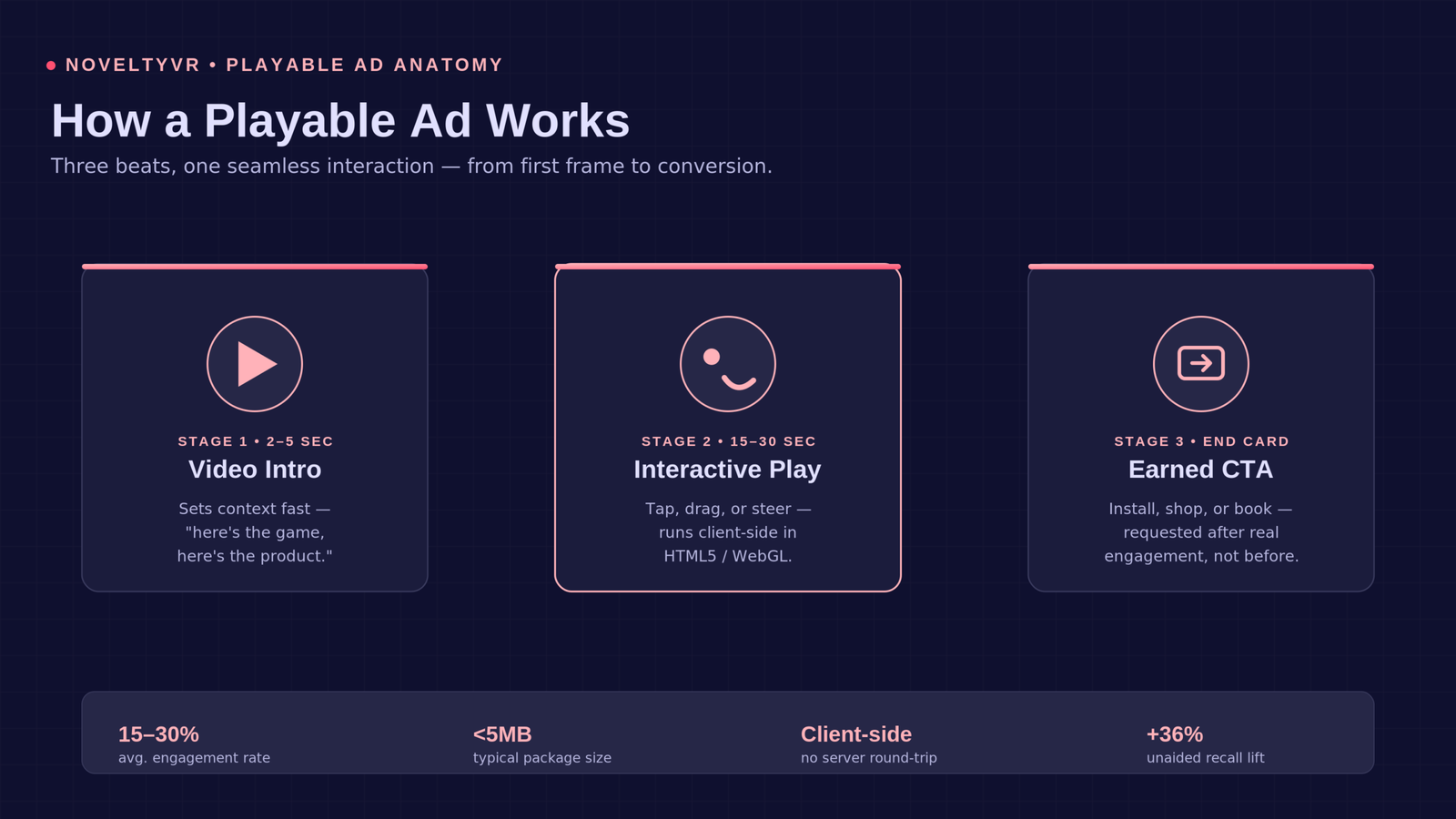
Structurally, most playable ads follow the same three-beat pattern:
- A short video or animated intro (2–5 seconds) that sets context — “here’s the game” or “here’s the product.”
- An interactive middle section built in HTML5 or WebGL, where the user taps, drags, matches, or steers something toward a small, satisfying win.
- An end card with a CTA — install, shop, book a demo — that appears once the user has already invested a few seconds of genuine attention.
That third beat is the whole point. By the time someone sees the CTA, they’ve already formed an opinion about the product based on direct experience, not a voiceover telling them how great it is. That’s a fundamentally different psychological starting point than a pre-roll ad, and it shows up in the numbers.
“The click happens after the experience, not instead of it. That ordering changes everything about lead quality.”
Playable ads were born in mobile gaming — they’re how studios like Zynga and Supercell let you “test drive” a game before installing it — but the format has since spread into ecommerce, fintech, automotive, and FMCG, which we’ll get into in Section 8.
2. How Do Playable Ads Actually Work?
Under the hood, a playable ad is a small, self-contained web app — usually built in HTML5, sometimes exported from a game engine like Unity via WebGL — packaged so it can run inside an ad network’s player without needing an app download or a script tag most publishers would never allow.
Here’s the technical chain, step by step:
Build. The interaction is built as a lightweight HTML5 experience — often under 5MB total, since most networks (TikTok, Meta, AppLovin) cap file size for load-speed reasons. Everything is bundled: HTML, CSS, JavaScript, and any images or sounds, compressed into a single package.
Package. The bundle is zipped according to each network’s spec. TikTok, for example, requires a root index.html file and a config.json that defines orientation (portrait, landscape, or both) and click behavior. Meta and Google Ad Manager have their own variations on the same idea (MRAID for Meta, VPAID/OMID conventions elsewhere).
Serve. When the ad wins an auction, the network’s player loads the zipped bundle inside a sandboxed webview or iframe. The intro video plays first — this is a fallback for networks or placements where full interactivity isn’t supported everywhere, and it buys loading time for the interactive layer.
Interact. The user takes over. Taps, drags, swipes, and simple physics (gravity, collision, matching logic) run entirely client-side in the browser — no server round-trip, which is why these ads have to stay lightweight and load in under a couple of seconds even on a mid-range Android phone.
Convert. After a fixed duration or on interaction completion, the end card appears with the CTA, wired to the network’s click-tracking so attribution still works normally.
The engineering constraint that shapes everything else is device diversity. A playable ad has to run acceptably on a five-year-old Android phone on patchy mobile data, which is why the best ones use simple 2D mechanics, minimal physics, and aggressive asset compression rather than trying to cram in 3D graphics that only render well on flagship devices.
3. Playable Ads vs. Video Ads vs. Static Ads: The Data
Numbers vary by source and vertical, but the direction is consistent across every study we looked at. Here’s how the three main formats stack up:
| Metric | Static/Banner | Video | Playable |
|---|---|---|---|
| Typical engagement rate | Under 1% | 2–5% (view-through) | 15–30% (play rate) |
| Relative conversion lift | Baseline | 1–2x banner | Up to 3–4x video (some studies report as high as 16x vs. non-playable) |
| Click-through rate | Baseline | 2–4x banner | Often 2–4x higher than standard video CTR |
| Unaided brand recall lift | Baseline | Moderate | +36% (IAB research) |
| Day-1 retention of converted users | Lower | Moderate | 30–40% better, since users self-qualify before converting |
| Production cost | Lowest | Low–Medium | Medium (more than video, less than a full app or game) |
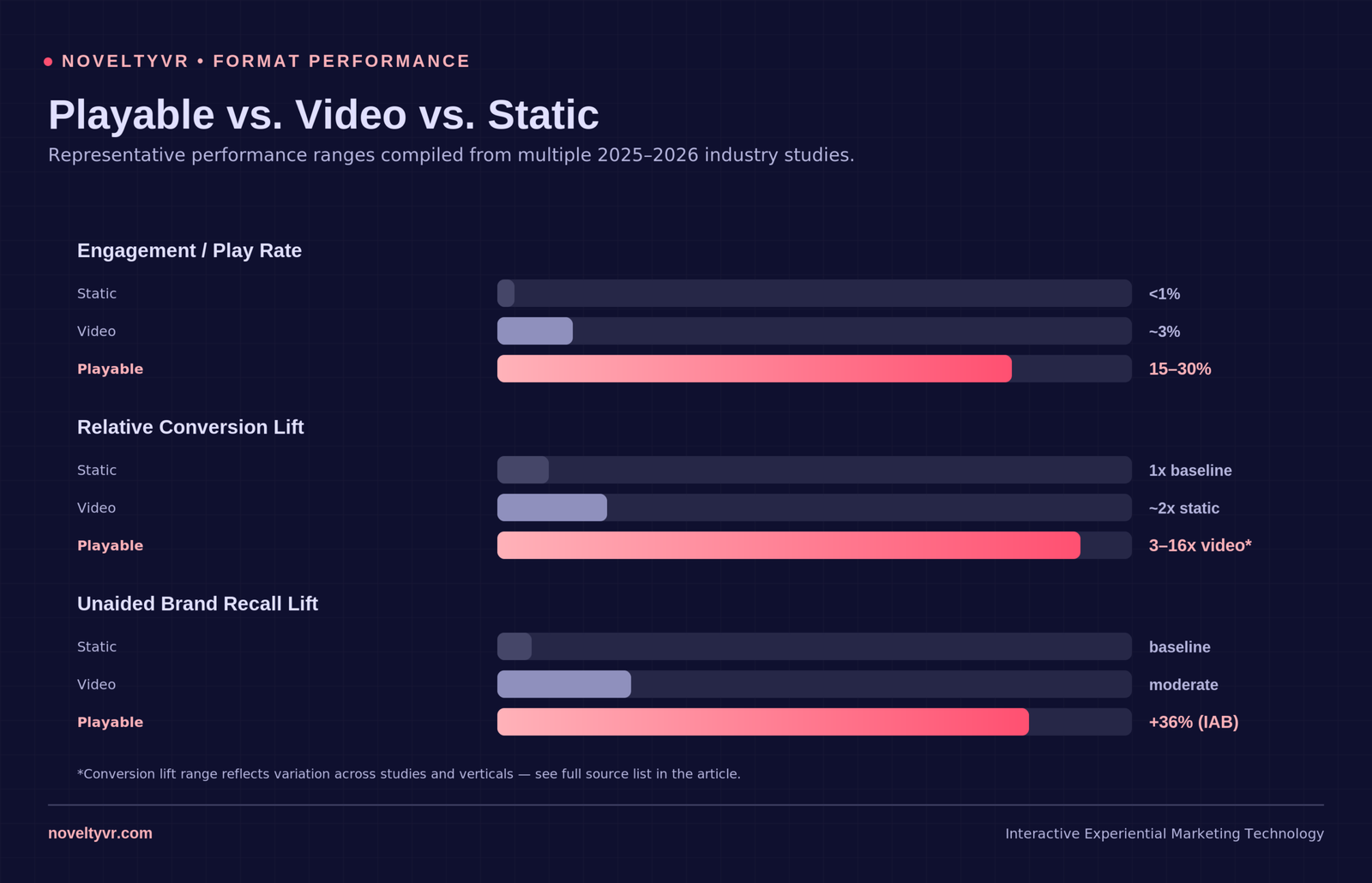
The retention line is the one that matters most and gets talked about least. Because the click only happens after someone has actually played, the users who convert from playable ads tend to already understand what they’re getting. That self-selection effect is why performance teams increasingly care less about raw CTR from playables and more about downstream metrics — Day 1 and Day 7 retention, cost per qualified action rather than cost per click.
One caution worth flagging here: a high CTR paired with a low engagement (play) rate is a red flag, not a win. It usually means a small, highly motivated sliver of users tapped through while everyone else bounced, which will distort your cost-per-result math if you’re not watching engagement rate alongside CTR.
4. Why the Format Outperforms (It’s Not Just Novelty)
It would be easy to chalk this up to shiny-new-thing bias, but the performance gap has held up for close to a decade now, across categories, which suggests something more structural is going on. Three mechanisms do most of the work:
Pre-qualification. Nobody plays a 20-second demo of a game they have zero interest in. The interaction itself filters for intent before the media spend converts into a click, which is exactly backward from how a banner ad works (click first, discover interest — or lack of it — later, at the advertiser’s expense).
The IKEA effect. Psychologists have shown for years that people value things more when they’ve put a small amount of effort into them. A user who steered the car around three turns feels a sliver of ownership over that outcome that a passive viewer of the same car in a video ad simply doesn’t get.
Memory encoding. Passive viewing and active doing are processed differently. This is well-documented in learning research and it applies just as well to advertising: things you do, you remember; things you watch, you mostly forget within the hour. That’s a large part of why unaided recall lifts show up in the IAB data cited above.
We’re deliberately keeping this section short because the psychology of why interactive formats work is a topic that deserves — and will get — its own deep dive on this blog. For now, the practical takeaway is: this isn’t a fad holding on by momentum. It’s exploiting a real, replicable quirk of how attention and memory work.
5. Real Examples of Playable Ads Done Well
New Balance’s playable banner. One of the more widely cited non-gaming examples: New Balance ran a simple “bounce the character off clouds to win a discount” playable that drove a reported 5% CTR to their ecommerce site — roughly ten times the average retail display benchmark of about 0.5%. Nothing about the mechanic was groundbreaking; the win was in matching a dead-simple game loop to a clear, immediate reward.
Gaming, still the format’s home turf. Studios like Zynga and mobile-first publishers built the playbook here: a 15-second slice of actual gameplay, tuned to be winnable, ending on an install prompt. The format works so well in-category because the ad and the product are the same thing — there’s zero gap between the promise and the experience.
FMCG and beverage brands. Larger consumer goods advertisers have used programmatic creative automation to produce playable and interactive variants at volume across markets — swapping in localized flavors, packaging, and offers without rebuilding the mechanic from scratch each time. The lesson for smaller brands: the mechanic is reusable infrastructure; only the skin needs to change per market or SKU.
Ecommerce and beauty. Rather than a game, several beauty and fashion advertisers have leaned into product-matching or styling interactions — pick a shade, style an outfit — that function as playable ads but double as a genuine (if brief) product-discovery moment.
Finance, cautiously. A handful of fintech and banking advertisers have tested interactive “savings scenario” or budget-simulation units in place of static rate-comparison banners. Early and still niche, but worth watching, since financial products are notoriously hard to make anyone care about in fifteen seconds of video.
The through-line across every example that has actually worked: the mechanic is dead simple, playable with one thumb, understandable in under two seconds, and tied to a reward or outcome the brand actually wants associated with itself.
6. Where Playable Ads Run: Platforms and Specs
Not every network treats playables the same way, and this trips up more campaigns than any creative problem does.
| Network | Format notes | Typical file size cap | Best for |
|---|---|---|---|
| Meta (Facebook/Instagram) | MRAID-based, video-first fallback | ~2–5MB | Broad reach, retargeting |
| TikTok | Requires index.html root file + config.json for orientation |
Under 5MB | Gen Z reach, high engagement inventory |
| Google AdMob / UAC | VPAID/OMID compliant, auto-scales across placements | Varies by placement | Mobile app install campaigns |
| AppLovin | Largest playable traffic share in mobile UA (~59% by some estimates) | Network-specific | Testing new concepts, scaling winners |
| Unity Ads | Native to gaming inventory | Network-specific | Gaming and gaming-adjacent audiences |
The practical implication: a playable built for one network’s spec doesn’t automatically work on another. Orientation handling, click-to-action triggers, and compression requirements all differ enough that “build once, run everywhere” usually means building once and then adapting the package per network — not literally reusing the same zip file.
7. What Do Playable Ads Cost in 2026?
Short version: expect somewhere between $3,000 and $25,000+ for a custom playable, depending on mechanic complexity, number of platform variants, and whether you need localization. No-code, template-based platforms can get you a basic version for a few hundred dollars a month, but you’re trading customization and brand fidelity for speed.
The bigger cost story, though, is on the media side. Because playable ads pre-qualify users, advertisers frequently report 20–30% lower cost-per-install compared to standard video, even though the playable itself costs more to produce than a static banner or a 15-second video cutdown. You’re paying more upfront for a creative asset that costs less to run at scale — which is the opposite of how most teams budget creative versus media, and worth explaining clearly to whoever signs off on the line item.
We’re covering agency and studio pricing tiers, what drives cost up or down, and how to negotiate a fair quote in a dedicated cost breakdown elsewhere on this blog — this section is meant to give you a realistic ballpark, not a full pricing teardown.
8. Beyond Gaming: Why Ecommerce, Finance, and FMCG Are Adopting Playables
For most of the format’s history, “playable ad” was shorthand for “mobile game ad.” That’s changing fast. The shift is being driven by a fairly simple economic argument: cost-per-action pressure is rising everywhere, third-party cookie deprecation has made broad retargeting less reliable, and any format that filters for genuine intent before the click is worth more than it used to be.
Fashion brands now let users style outfits inside the ad unit itself. Beauty brands run shade-matching simulations. Automotive advertisers offer scaled-down configurators — pick a color, pick a trim — directly inside paid social placements, well before the user ever lands on a website. None of this required reinventing playable ad technology; it required someone willing to apply gaming-industry creative discipline to a category that had never used it before.
The FMCG sector, still the single largest spender in global digital advertising by share, is a natural next frontier here — not because the format is inherently suited to consumer packaged goods, but because FMCG marketing has always been about the smallest possible unit of delight (a jingle, a mascot, a slogan), and a fifteen-second playable moment fits that mold better than most digital formats invented in the last decade.
9. How AI Is Changing Playable Ad Production
Two years ago, building a playable ad meant a small team of developers and designers working for two to four weeks per unit. That timeline is compressing, and AI is most of the reason why.
Production speed. No-code and AI-assisted tooling now lets teams produce interactive ad variants roughly three times faster than fully manual builds, largely by automating asset resizing, network-specific packaging, and basic QA across device profiles.
Dynamic creative at scale. Rather than hand-building five versions of a playable for five markets, teams are generating variant sets — different colors, offers, languages, difficulty curves — from a single base mechanic, with AI handling the permutation work.
Smarter tuning, not just faster building. AI is also being used inside the experience itself: dynamic difficulty adjustment (so the mini-game feels winnable regardless of skill level), and creative-element testing that swaps in the highest-performing variant automatically rather than waiting for a human to review a weekly report.
A word of caution. None of this replaces the judgment of someone who understands game feel — timing, feedback, the tiny dopamine hit of a satisfying “win” animation. AI is very good at producing more variants, faster. It is not yet good at knowing which mechanic will actually feel fun to a stranger holding a phone on a train. That’s still a human craft problem, and the brands getting the best results are the ones treating AI as a production accelerant rather than a creative replacement.
10. Common Mistakes That Kill Performance
A few patterns show up repeatedly in underperforming playable ads:
Overcomplicated mechanics. If a first-time player can’t understand the goal within two seconds, you’ve already lost most of your audience. The best-performing units studied across industry benchmarks include a tutorial prompt or logo cue in the vast majority of top-performing creative — simplicity isn’t a compromise, it’s the format working as designed.
Missing or weak CTAs. Roughly half of top-performing playables include a clear, action-oriented CTA (“Try Now,” “Download,” “Shop the Look”). A vague or absent CTA at the end card wastes the exact moment the user is most primed to act.
Ignoring platform specs. Building for one network’s file size and orientation rules, then submitting the same package everywhere, is the single most common (and most avoidable) reason a playable gets rejected or underperforms on a second platform.
Skipping low-end device testing. A mechanic that runs beautifully on a design team’s iPhone can stutter or fail entirely on the mid-range Android devices that make up a huge share of real ad inventory in many markets.
Treating it as a one-off. The brands getting compounding value from this format treat the mechanic as reusable infrastructure — swapping skins, offers, and localization on top of a proven interaction — rather than rebuilding from zero for every campaign.
11. How to Brief or Choose a Playable Ad Partner
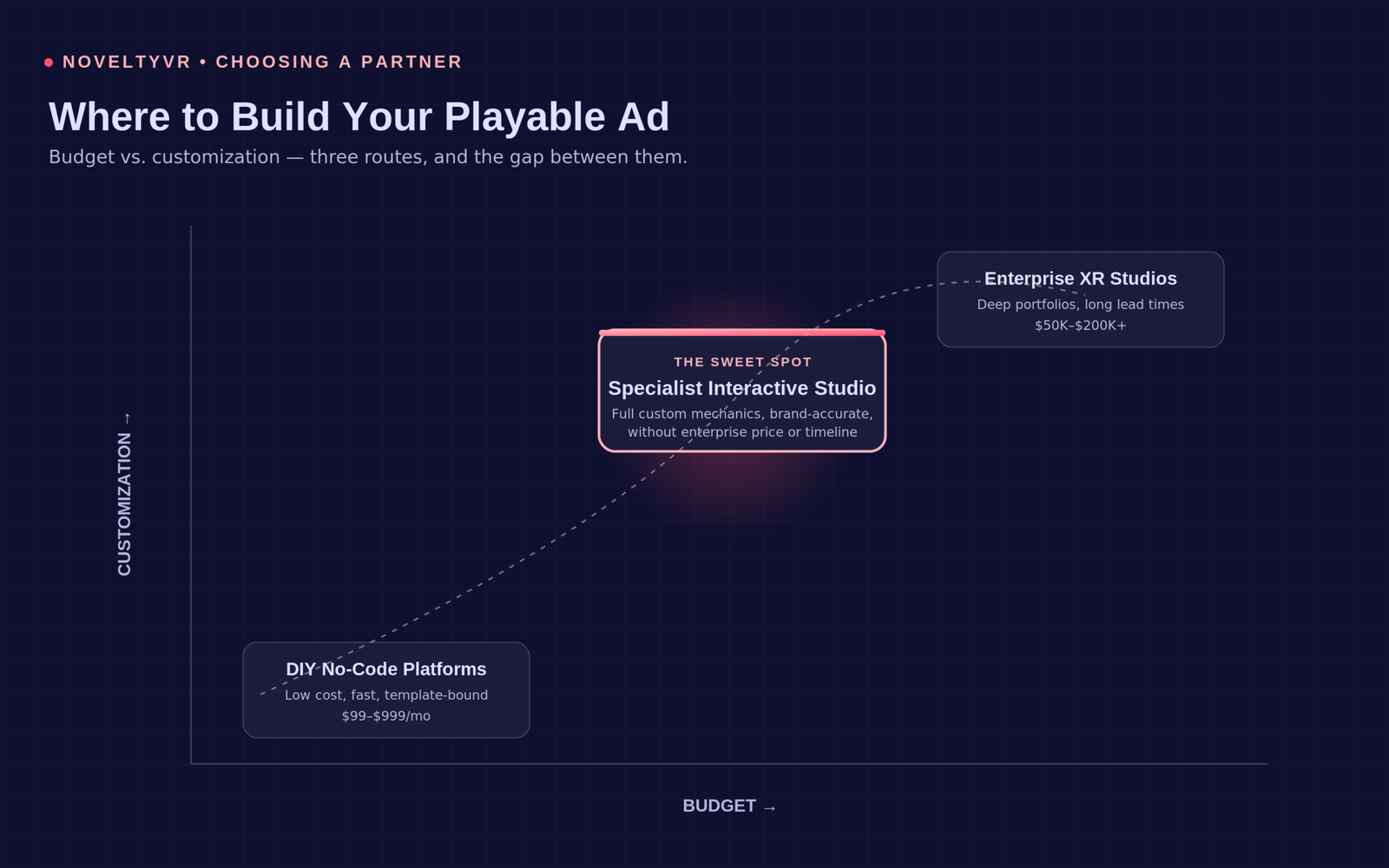
Broadly, you have three options, and they suit different situations:
DIY no-code platforms (self-serve, template-based) are genuinely good if you need something fast, cheap, and are comfortable with visible template constraints. You won’t get custom mechanics or tight brand fidelity, but you’ll get something live in days.
Large XR/interactive studios typically bring strong portfolios and deep production capability, at a price point ($50K–$200K+ for full campaigns) that puts them out of reach for anything but the largest brand budgets, with longer lead times to match.
Specialist interactive studios sit in between: custom mechanics and brand-accurate creative, without the enterprise studio price tag or timeline, usually by combining game-development talent with a marketing-outcome focus rather than treating the project as pure art.
Whichever route you choose, a good brief includes: the core action or product moment you want people to experience, the platforms you’re running on (so specs are built in from day one, not retrofitted), your KPI hierarchy (engagement rate vs. install rate vs. downstream retention — decide which matters most before you start), and a realistic timeline. Four to six weeks is typical for a fully custom build with two rounds of revision; anything promising a polished custom mechanic in under two weeks is worth a second look.
This is exactly the gap NoveltyVR was built to sit in — full custom interactive development (playable ads, gamified microsites, 3D configurators) at a fraction of the large-studio price point, without the template ceiling of the DIY platforms. If you’re evaluating options, it’s worth asking any prospective partner for a live demo you could plausibly show your own client or leadership team — take a look at our portfolio for a sense of what that looks like in practice, rather than just a case study PDF.
12. FAQ
What are playable ads and how do they work?
A playable ad is a short interactive ad — usually 15 to 30 seconds — that lets a user try a mini version of a product or game before clicking a call-to-action. It runs as a lightweight HTML5 or WebGL package inside the ad network’s player: a brief video intro, an interactive middle section, then an end card with the CTA.
How do playable ads compare to video ads in performance?
Across multiple industry studies, playable ads show conversion lifts ranging from roughly 3x to as high as 16x over standard video, along with 2–4x higher click-through rates and 30–40% better post-conversion retention, because users self-select before they click.
What is the average cost of a playable ad?
Custom playable ads typically run from $3,000 to $25,000+ depending on mechanic complexity and the number of platform variants needed. Template-based, no-code platforms are available for a few hundred dollars a month but limit customization.
How long does it take to build a playable ad?
A fully custom playable, including platform-specific packaging and QA, typically takes four to six weeks with one to two rounds of revision. No-code template builds can go live in days.
What formats do playable ads support — HTML5 vs. WebGL?
Most playable ads are built in HTML5 for broad compatibility and small file size. WebGL (often exported from Unity) is used for more visually complex 3D mechanics, but requires careful optimization since it’s more demanding on lower-end devices.
What is a good engagement rate for a playable ad?
Industry benchmarks generally consider 15–30% engagement (the percentage of viewers who interact rather than just watch) to be a healthy range. Anything notably lower usually signals the mechanic isn’t intuitive enough within the first two seconds.
Are playable ads only for mobile games?
No — while the format originated in mobile gaming, ecommerce, fashion, beauty, automotive, fintech, and FMCG brands are all now using playable-style interactions for product demos, configurators, and lead capture.
Do playable ads work on Meta and TikTok the same way?
Not exactly. Each network has its own technical spec — TikTok requires a specific file structure and orientation config, Meta uses an MRAID-based framework — so a playable typically needs to be repackaged, not just re-uploaded, for each platform.
13. Key Takeaways
- Playable ads let users experience a product before clicking, which pre-qualifies intent and consistently outperforms static and video formats on conversion and retention.
- The format’s engineering constraints (small file size, cross-device performance, network-specific packaging) matter as much as the creative mechanic itself.
- Simplicity wins: the best-performing playables are understandable within two seconds and playable with one thumb.
- Non-gaming categories — ecommerce, fintech, FMCG, automotive — are now the fastest-growing adopters of the format.
- AI is compressing production timelines and enabling variant-at-scale creative, but the core mechanic still needs human game-design judgment.
- Choosing the right production partner (DIY platform, enterprise studio, or specialist interactive studio) should be based on budget, timeline, and how much customization your brand actually needs.
14. Conclusion
Playable ads aren’t a gimmick that happened to work once and got written up in a case study deck. They’re a structural response to a problem every advertiser now faces: attention is scarce, skepticism is high, and asking someone to simply believe your ad copy is a harder sell every year. Letting them find out for themselves, in fifteen seconds, on their own terms, is a genuinely different value exchange — and the data has backed that up consistently for close to a decade.
If you’re weighing whether this format is worth the investment for your next campaign, the honest answer is: it depends on whether you have a product moment worth letting someone try. If you do, this is one of the few ad formats built to prove it rather than just claim it.
Want to see what a playable ad built for your brand could look like? Book a strategy call with NoveltyVR and we’ll walk you through examples relevant to your category, timeline, and budget.
Pingback: Interactive Ads vs Video Ads: 2026 Data Comparison
Pingback: 10 Playable Ad Examples That Outperform Video Ads (2026)